Product Description
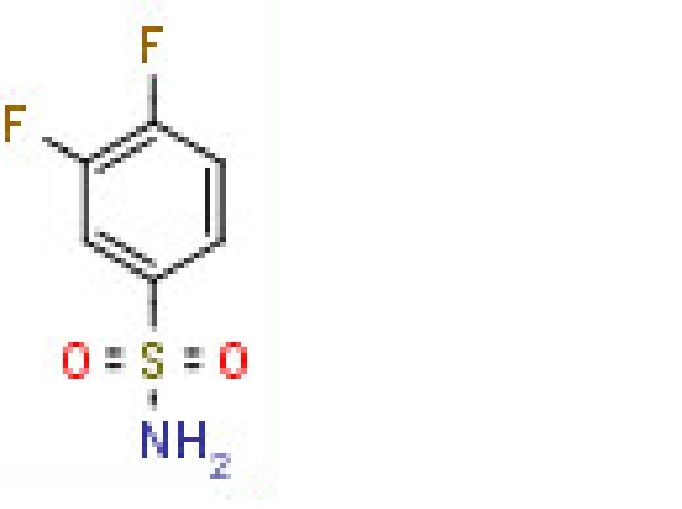
Chemical Name:3,4-Difluorobenzenesulfonamide
Synonyms :3,4-Difluorobenzenesulfonamide
CAS No : 108966-71-8
Purity : 97%
Molecular Formula: C6H5F2NO2S
Molecular Weight:193.2
Appearance : SolidVersatile Research and Industrial Applications3,4-Difluorobenzenesulfonamide serves as a valuable reagent and intermediate for pharmaceutical, agrochemical, and general chemical research purposes. Its consistent quality and high purity make it suitable for laboratory-scale synthesis and analytical processes, especially where precision and reliability are essential.
Chemical Properties and HandlingThis compound is stable at room temperature and pressure, with minimal volatility and low reactivity under standard laboratory conditions. It is odorless or only mildly scented, with a crystalline structure and a melting point of 139143C. Safe handling with typical laboratory protection is recommended, as it may cause mild irritation to the skin or eyes.
Storage and Shelf Life3,4-Difluorobenzenesulfonamide should be stored in a cool, dry, and well-ventilated environment, away from incompatible substances to maintain its stability. Under these optimal storage conditions, the product retains its stability and effectiveness for up to 24 months.
FAQs of 3,4- Difluorobenzenesulfonamide:
Q: How should 3,4-Difluorobenzenesulfonamide be stored to maintain its quality?
A: To preserve its stability and purity, store the compound in a tightly sealed container in a cool, dry, and well-ventilated area, away from incompatible substances and moisture.
Q: What are the primary uses of 3,4-Difluorobenzenesulfonamide?
A: It is primarily used as a reagent and intermediate in pharmaceutical development, agrochemical synthesis, and chemical research applications due to its high purity and consistent properties.
Q: When does the product need to be replaced or disposed of?
A: 3,4-Difluorobenzenesulfonamide has a shelf life of 24 months when stored under recommended conditions. Replace the product if it has exceeded this period or if any signs of contamination or degradation are observed.
Q: Where can this compound be safely transported or shipped?
A: It is classified as non-hazardous for transport and can be shipped domestically and internationally, provided standard packaging and handling measures are followed.
Q: What benefits does this compound provide in research or industrial processes?
A: Its high purity, stability under normal laboratory conditions, and well-defined properties ensure reliable results in synthesis, analysis, and formulation activities.
Q: Is special personal protective equipment (PPE) required during handling?
A: While the compound is non-poisonous with standard laboratory practices, it may cause mild skin or eye irritation; thus, laboratory gloves, goggles, and protective clothing are advised during handling.






 Send Inquiry
 Send Inquiry
 Send SMS
 Call Me Free


