Product Description
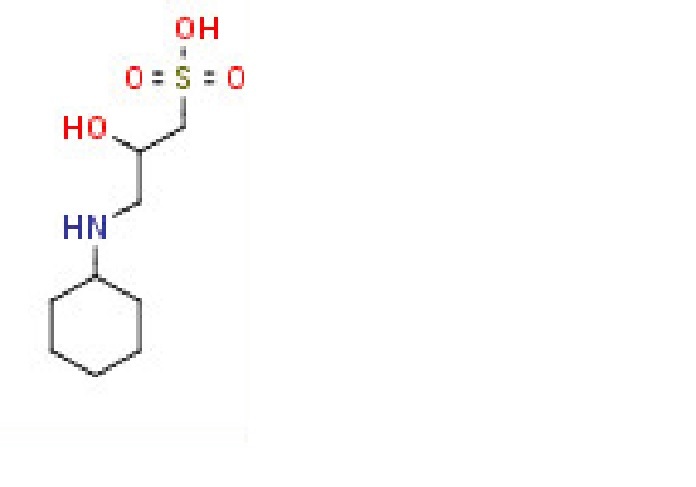
Chemical Name:3-(Cyclohexylamino)-2-hydroxy-1-propanesulfonic
acid
Synonyms : 1-Propanesulfonic acid,3-(cyclohexylamino)-2-hydroxy-
1Propanesulfonicacid, 3(cyclohexylamino)2hydroxy
CAS No : 73463-39-5
Purity : 97%
MolecularFormula : C9H19NO4S
Molecular Weight: 237.3
Appearance: SolidReliable Buffering Agent for Advanced Biochemical ApplicationsCAPSO provides a stable and efficient buffering capacity for a variety of laboratory and industrial applications. Its zwitterionic nature, high purity, and broad buffer range make it particularly valuable for protein purification, electrophoresis, and other biochemical processes. This analytical-grade compound is favored for its biocompatibility and chemical resilience under standard storage conditions, extending its utility in rigorous research environments.
Key Features and SpecificationsCAPSO stands out due to its excellent solubility in water, non-toxic profile, and odorless nature. With a molecular formula of C9H19NO4S and a melting point of 151-155C, it maintains stability across a five-year shelf life. The compound is available in various packaging sizes, ensuring flexibility for different scales of laboratory or production requirements. Classification as non-hazardous and non-dangerous ensures ease of storage and compliance.
FAQ's of 3-(Cyclohexylamino)-2-hydroxy-1-propanesulfonic acid:
Q: How is CAPSO used in protein purification and electrophoresis?
A: CAPSO acts as a buffering agent, maintaining a stable pH environment essential for protein stability and separation during purification and electrophoresis. Its effective buffer range of 8.9 to 10.3 is ideal for these biochemical processes.
Q: What are the main benefits of choosing CAPSO as a buffer?
A: CAPSO offers high chemical stability, excellent water solubility, and biocompatibility. Its zwitterionic nature reduces interference with biochemical reactions and ensures compatibility with sensitive biological samples.
Q: When should CAPSO be used over other buffers?
A: CAPSO is preferable when a high-pH buffer is required, especially within the 8.9-10.3 range, such as in specific protein studies, enzyme assays, or electrophoresis where minimal interference is essential.
Q: Where should CAPSO be stored to maintain its quality?
A: CAPSO should be stored in a tightly closed container at ambient temperature, in a dry place, to maintain its stability and extend its shelf life up to five years.
Q: What is the process for preparing CAPSO buffer solutions?
A: Dissolve the desired amount of CAPSO powder in distilled water, then adjust the pH as needed with acid or base. Ensure thorough dissolution for a homogenous buffer solution suitable for laboratory applications.
Q: Is CAPSO considered hazardous or regulated for transport?
A: No, CAPSO is non-hazardous according to GHS and is classified as non-dangerous for transport, allowing for safe handling and easy distribution.
Q: What packaging sizes are available for CAPSO and how can it be sourced?
A: CAPSO is available in 25g, 100g, 500g, and 1kg bottles or drums. It can be sourced from suppliers and traders in India, ensuring reliable supply for laboratory and industrial needs.






 Send Inquiry
 Send Inquiry
 Send SMS
 Call Me Free


