Product Description
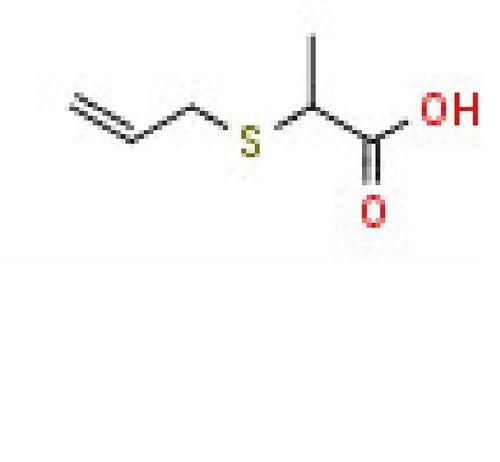
Chemical Name: 2-(Allylthio)propanoicacid
Synonyms :2-prop-2-enylsulfanylpropanoic acid
| 2-(prop-2-en-1-ylsulfanyl)propanoic acid
| 2-(allylthio)propanoicacid
Cas No : 54680-83-0
Purity : 97%
MolecularFormula : C6H10O2S
Molecular Weight: 146.2
Versatile Chemical Intermediate2-(Allylthio)propanoic acid is valued in organic synthesis and pharmaceutical research for its reactive allylthio group. Its structure enables it to serve as an intermediate or reagent in a variety of chemical processes, enhancing synthetic pathways with precision and reliability.
Safe Handling and StorageThe compound is stable under recommended storage conditions but may decompose after extended exposure to air or light. It is packaged in amber glass bottles that protect it from light, maintaining its integrity. Always store in a cool, dry, well-ventilated area and avoid contact with oxidizing agents and sources of ignition.
Physical and Chemical PropertiesCharacterized by a melting point of 31-33C and a boiling point of 116-118C at 14 mmHg, 2-(Allylthio)propanoic acid has a density of 1.11 g/cm3 and a refractive index of approximately 1.517. Its acidic nature and sulfurous aroma are notable, and it is only slightly soluble in water but dissolves well in ethanol and other organic solvents.
FAQ's of 2-(Allylthio)propanoic acid:
Q: How should 2-(Allylthio)propanoic acid be stored to ensure maximum shelf life?
A: For optimal stability, store 2-(Allylthio)propanoic acid in a cool, dry, and well-ventilated area, away from light, sources of ignition, and strong oxidizing agents. When protected from prolonged exposure to air or light, the compound maintains integrity for up to 24 months.
Q: What protective measures should be taken when handling 2-(Allylthio)propanoic acid?
A: Always wear protective gloves and avoid inhalation or direct contact with skin and eyes, as the compound can cause irritation and is harmful if swallowed or inhaled in quantity. Handle in a well-ventilated environment and follow standard laboratory safety protocols.
Q: Where is 2-(Allylthio)propanoic acid commonly applied in research or industry?
A: This compound finds use primarily as an intermediate in pharmaceutical synthesis, organic reactions, and research settings due to its highly reactive allylthio group and favorable properties for laboratory-scale chemical processes.
Q: When should the product be replaced or disposed of?
A: 2-(Allylthio)propanoic acid should be replaced or properly disposed of if it shows signs of decomposition, such as changes in appearance or odor, or when it reaches the end of its 24-month shelf life. Disposal must comply with local hazardous waste regulations.
Q: What are the benefits of using amber glass bottles for packaging this compound?
A: Amber glass bottles shield the acid from light, reducing the risk of decomposition and ensuring the compound's purity and stability. These packages also prevent contamination and facilitate safe transportation and handling.
Q: How is 2-(Allylthio)propanoic acid typically used in laboratory settings?
A: Researchers use this compound as a reagent or intermediate in organic synthesis and pharmaceutical development, leveraging its chemical reactivity to create more complex molecules for study or further processing.






![(1S,2R,3R,4S)-3-(Aminocarbonyl)bicyclo[2.2.1]hept-5-ene-2-carboxylic acid](https://cpimg.tistatic.com/09760741/b/4/-1S-2R-3R-4S-3-Aminocarbonyl-bicyclo-2-2-1-hept-5-ene-2-carboxylic-acid.jpg?tr=w300)
 Send Inquiry
 Send Inquiry
 Send SMS


