Product Description
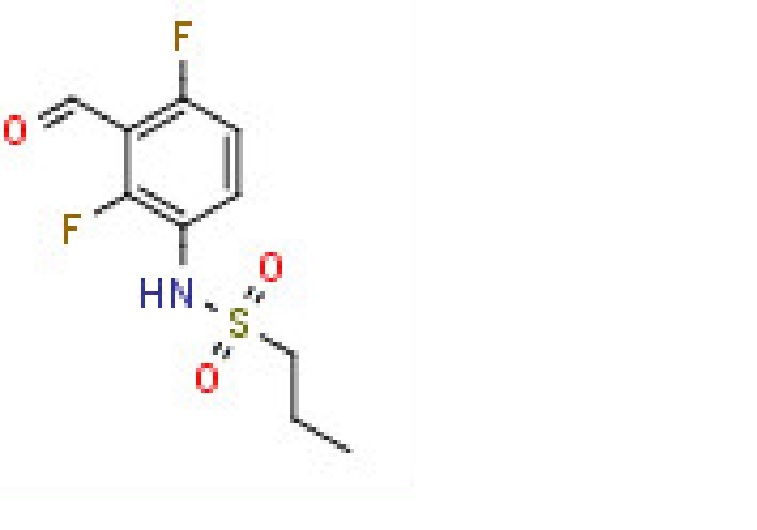
Chemical Name: N-(2,4-Difluoro-3-formylphenyl)propane-1-sulfonamide
Synonyms :N-(2,4-Difluoro-3-formylphenyl)-1-propanesulfonamide
CAS No : 918523-58-7
Purity : 95%
MolecularFormula : C10H11F2NO3S
Molecular Weight:263.3
Appearance : SolidApplications & BenefitsThis compound serves as a key intermediate for the synthesis of pharmaceutical compounds and is widely utilized in chemical research. Its high purity and reliability under standard storage conditions make it suitable for research laboratories seeking reproducible results. Researchers benefit from its stability and well-documented identification methods, permitting precise application in experimental protocols.
Safe Handling & StorageTo ensure safety, always wear gloves, a mask, and safety goggles when handling this product. Avoid inhalation and direct contact with skin or eyes. Store the material in a tightly closed container, in a cool, dry, and well-ventilated environment. Adhering to recommended storage and handling practices preserves the compound's quality and extends its shelf life to up to two years.
FAQ's of N-(2,4-Difluoro-3-formylphenyl) propane-1-sulfonamide:
Q: How should N-(2,4-Difluoro-3-formylphenyl) propane-1-sulfonamide be handled safely in the laboratory?
A: Always employ appropriate protective equipment including gloves, mask, and safety goggles. Avoid any inhalation or direct skin contact, and handle the compound in a well-ventilated area in accordance with chemical handling guidelines.
Q: What are the main uses of this compound?
A: N-(2,4-Difluoro-3-formylphenyl) propane-1-sulfonamide is primarily utilized as an intermediate in the synthesis of pharmaceutical compounds and for various applications in chemical research.
Q: When does this product decompose, and what is its melting point?
A: The compound decomposes before reaching its boiling point and has a melting point in the range of 140-144C.
Q: Where should this compound be stored for maximum stability?
A: It should be stored in a tightly sealed container, kept in a cool, dry, and well-ventilated area to ensure optimal stability and maintain its shelf life.
Q: What identification methods are available for this chemical?
A: Standard identification techniques include Nuclear Magnetic Resonance (NMR), Infrared Spectroscopy (IR), Mass Spectrometry (MS), and High-Performance Liquid Chromatography (HPLC).
Q: What are the packaging options for this product?
A: This compound is typically supplied in sealed HDPE bottles or glass bottles to ensure chemical stability during storage and transport.
Q: What is the benefit of using this product in research?
A: Owing to its high purity, stability under recommended storage, and reliable characterization data, the compound ensures reproducible and consistent outcomes, which is highly beneficial for research and pharmaceutical development.






![N-cyclopropyl-4-hydroxy-N-[(4-methoxyphenyl)methyl]benzene-1 -sulfonamide](https://cpimg.tistatic.com/10866574/b/4/N-cyclopropyl-4-hydroxy-N-4-methoxyphenyl-methyl-benzene-1-sulfonamide.jpg?tr=w300)
 Send Inquiry
 Send Inquiry
 Send SMS
 Call Me Free


