Product Description
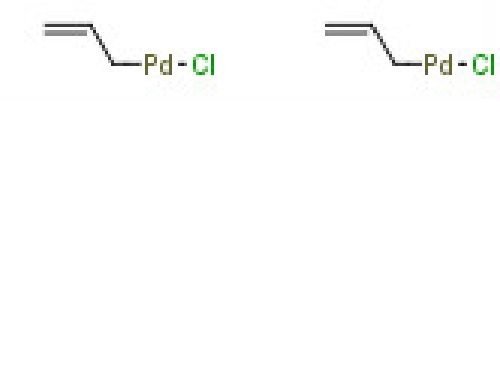
Chemical name: Allylpalladium(ii) chloridedimer
Synonyms: Palladium,di-.mu.-chlorobis(.eta.3-2-propenyl)di-
Palladium,di-mu-chlorobis(eta3-2-propenyl)di-(9CI)
Allyl palladium (II) chloride dimer
Cas no: 12012-95-2
Purity: 98%
Molecular formula: 2C3H5ClPd
Molecular Weight:365.9
Appearance:solid Highly Effective Coupling CatalystAllylpalladium(II) chloride dimer is renowned for its role as a catalyst in contemporary organic synthesis, particularly in Heck, Suzuki, and other cross-coupling reactions. Its distinctive square planar palladium complex geometry enables efficient bond formation between organic molecules, making it invaluable for constructing complex molecular architectures in pharmaceutical and advanced material research.
Safe Handling and StorageGiven its toxicity (H301), skin (H315) and eye (H319) irritation risks, and sensitivity to air and moisture, handling safety is imperative. The compound must be stored in airtight containers under an inert atmosphere, away from oxidizers, acids, and light. Users should always wear suitable protective clothing, gloves, and eyewear to minimize exposure and ensure safe laboratory practices.
FAQ's of Allylpalladium(ii) chloride dimer:
Q: How should Allylpalladium(II) chloride dimer be stored to maintain its stability?
A: It should be stored in a sealed, air-tight bottle under an inert gas atmosphere (such as nitrogen or argon), protected from light and moisture. This protects the sensitive palladium complex from decomposing or reacting with air and humidity.
Q: What are the main applications of Allylpalladium(II) chloride dimer in organic synthesis?
A: This compound is commonly used as a catalyst in cross-coupling reactions, such as the Heck and Suzuki reactions, enabling the efficient formation of carbon-carbon bonds crucial for pharmaceuticals and advanced material synthesis.
Q: When is it necessary to use personal protective equipment while handling this compound?
A: Personal protective equipment (PPE) including gloves, protective clothing, and eye protection must be worn at all times when handling Allylpalladium(II) chloride dimer, due to its toxicity and irritating properties (H301, H315, H319).
Q: Where should this product not be used or stored?
A: It should not be used or stored near strong oxidizers, acids, or in humid environments. Exposure to air or moisture can degrade the compound, affecting its effectiveness and safety.
Q: What precautions must be taken during the preparation and usage process?
A: During preparation and use, avoid inhaling dust, fumes, or vapors (P261). Always work in a well-ventilated area or fume hood, and ensure all containers remain tightly sealed when not in use to maintain compound integrity.
Q: How does using Allylpalladium(II) chloride dimer benefit organic synthesis processes?
A: Its use as a catalyst enables highly selective and efficient coupling reactions, allowing chemists to build complex organic molecules with greater precision and yield, thus advancing research and industrial processes.






![2-((2S,3S)-4-(Anthracen-9-yl)-3-(tert-butyl)-2,3-dihydrobenzo[d][1,3] oxaphosphol-2-yl)pyridine](https://cpimg.tistatic.com/13197771/b/4/2-2S-3S-4-Anthracen-9-yl-3-tert-butyl-2-3-dihydrobenzo-d-1-3-oxaphosphol-2-yl-pyridine.jpg?tr=w300)
 Send Inquiry
 Send Inquiry
 Send SMS
 Call Me Free


