Product Description
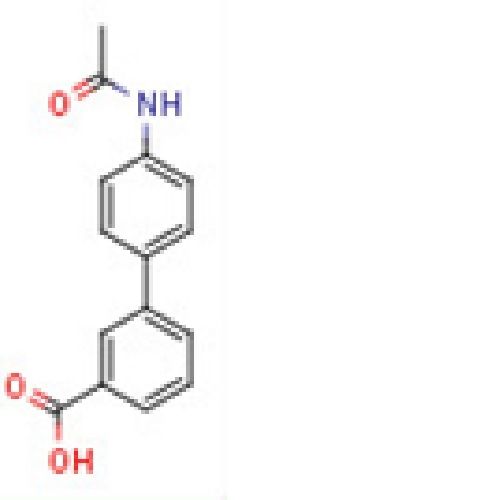
Chemical Name: 4-Acetamidobiphenyl-3-carboxylicacid
Synonyms :4-Acetamidobiphenyl-3-carboxylicacid|4-Acetamido-[1,1-biphenyl]-3-carboxylic acid|3-(4-acetamidophenyl)benzoicacid|4-(Acetylamino)[1,1-biphenyl]-3-carboxylic acid
Cas No : 893737-71-8
Purity : 97%
MolecularFormula : C15H13NO3, Molecular Weight : 255.3
Appearance: SOLIDStable, High-Purity Chemical IntermediateThis compound stands out for its exceptional stability under standard storage conditions and over 98% purity. The product is ideally suited for laboratory synthesis, pharmaceutical research, and the pigment and dye industry, offering reliable analytic performance and consistent quality for advanced applications.
Safe Handling and Non-Hazardous Transport4-Acetamidobiphenyl-3-carboxylic acid poses no known significant hazards and is non-poisonous, making it safe to handle with standard laboratory practices. Its packaging in robust HDPE bottles ensures material integrity and facilitates easy transport, without special hazardous material protocols.
Comprehensive Analytical SupportAnalytical methods such as HPLC, NMR, and IR spectroscopy are recommended for purity and identity verification. This ensures researchers and industrial users have confidence in the products quality and composition, supporting accurate results in research and formulation tasks.
FAQs of 4-Acetamidobiphenyl-3-carboxylic acid:
Q: How should 4-Acetamidobiphenyl-3-carboxylic acid be stored for maximum stability?
A: Store the compound in a tightly sealed container, in a cool, dry place, and away from incompatible substances. This ensures stability and maintains quality for up to 24 months.
Q: What are the main uses of 4-Acetamidobiphenyl-3-carboxylic acid in laboratory and industrial settings?
A: It is mainly used as an intermediate in pharmaceutical research, chemical synthesis, and the production of dyes and pigments. Its high purity makes it suitable for research applications requiring reliable results.
Q: When is it best to use this compound during synthesis or research?
A: Use 4-Acetamidobiphenyl-3-carboxylic acid at stages where an acetamidobiphenyl moiety is required for further derivatization in multi-step organic syntheses or when establishing reference samples in analytical research.
Q: Where can information about its structural formula and properties be verified?
A: Structural and property information can be confirmed using chemical databases or by employing analytical techniques such as HPLC, NMR, and IR spectroscopy. The CAS number 70953-76-9 can be used for reference.
Q: What process is recommended for verifying the purity and quality of this compound?
A: Purity and quality are best assessed using HPLC analysis, supported by NMR and IR spectroscopy. This confirms impurity levels are below 2% and verifies compliance with research standards.
Q: What are the benefits of choosing this product for research or industrial synthesis?
A: Key benefits include its high stability, >98% purity, absence of significant hazards, and consistent crystalline form. Its versatility makes it suitable across various chemical, pharmaceutical, and dye synthesis processes.
Q: How is the product packaged for shipment, and is it considered hazardous for transport?
A: The compound is packaged in HDPE bottles available in 25g, 100g, or 500g sizes. It is not classified as hazardous for transport, facilitating straightforward and safe shipping.






![(3As*,6as*)-tert-butylhexahydropyrrolo [3,4-c]pyrrole-2(1H)-carboxylate](https://cpimg.tistatic.com/10021333/b/4/-3As-6as-tert-butylhexahydropyrrolo-3-4-c-pyrrole-2-1H-carboxylate.jpg?tr=w300)
 Send Inquiry
 Send Inquiry
 Send SMS


