Product Description
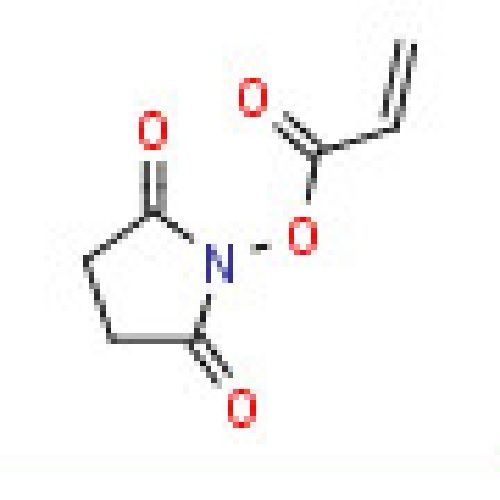
Chemical Name: N-Acryloxysuccinimide
Synonyms :2,5-Dioxopyrrolidin-1-yl acrylate
| N-Acryloxysuccinimide
| Acrylic acid N-hydroxysuccinimide ester
| N-Succinimidyl acrylate
Cas No : 38862-24-7
Purity : 97%
MolecularFormula : C7H7NO4
Molecular Weight:169.1
Appearance:SolidPrecise Applications in BioconjugationDue to its reactive NHS-ester group, N-Acryloxysuccinimide is ideal for forming stable amide bonds with amines, facilitating protein or peptide conjugation, and linker chemistry. Its high purity ensures consistency and reliability for research and industrial applications, including synthetic pathways.
Safe Handling and Storage RecommendationsUsers should handle N-Acryloxysuccinimide in a well-ventilated area and avoid direct contact or inhalation due to possible irritation. Always use personal protective equipment (PPE). Store in a cool, dry place within a tightly sealed container, shielded from moisture and light for a shelf life of up to two years.
Flexible Packaging OptionsThis product is available in high-quality HDPE bottles or glass vials, according to user preference. Each package is designed to maintain compound integrity during transportation and storage, with a minimum supply starting at 1 gram to accommodate varied research and industrial needs.
FAQ's of N- Acryloxysuccinimide:
Q: How should N-Acryloxysuccinimide be stored to maintain its stability?
A: N-Acryloxysuccinimide should be stored in a cool, dry place, away from light and moisture, and in a tightly sealed container. Proper storage conditions help preserve its stability for up to two years.
Q: What are the main applications of NHS-acrylate in research and industry?
A: This compound is mainly used for amine-reactive labeling in bioconjugation, linker chemistry, and organic synthesis. Its NHS group enables efficient conjugation to proteins, peptides, or other amine-containing molecules.
Q: When is personal protective equipment (PPE) required during handling?
A: PPE is mandatory at all times when working with N-Acryloxysuccinimide because of its potential to irritate skin, eyes, or the respiratory tract. Use gloves, lab coats, and eye protection, and handle in a well-ventilated area.
Q: Where can N-Acryloxysuccinimide be packaged for purchase?
A: The product is available in HDPE bottles or glass vials, as per request, ensuring safe storage and transportation. Packaging options can be selected based on specific laboratory or industrial requirements.
Q: What is the process for using N-Acryloxysuccinimide in bioconjugation?
A: Dissolve the compound in a suitable anhydrous organic solvent (such as DMSO or DMF) and combine it with the amine-containing target under controlled conditions, avoiding contact with water to prevent hydrolysis.
Q: What benefits does high-purity N-Acryloxysuccinimide provide?
A: With purity above 98%, this compound ensures high reactivity and consistent results, making it suitable for sensitive analytical procedures, synthetic applications, and bioconjugation protocols where reliable outcomes are essential.
Q: Is N-Acryloxysuccinimide toxic or poisonous for laboratory use?
A: The compound is not classified as poisonous but should still be treated as a chemical reagent and handled with care to minimize exposure and prevent irritation. It is not intended for consumption.






![6-Amino-[1,2,4]triazine-5-carboxylic acid](https://cpimg.tistatic.com/09993037/b/4/6-Amino-1-2-4-triazine-5-carboxylic-acid.jpg?tr=w300)
 Send Inquiry
 Send Inquiry
 Send SMS


