Product Description
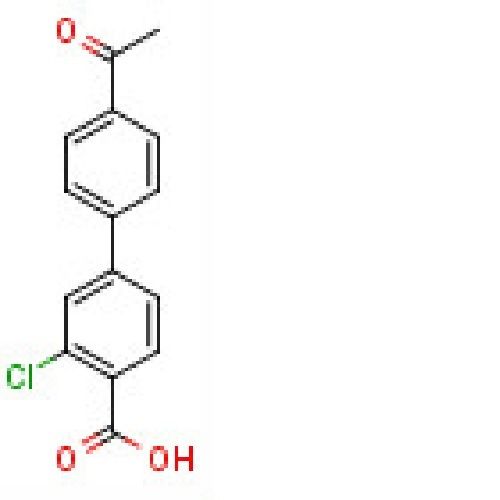
Chemical Name: 4-(4-Acetylphenyl)-2-chlorobenzoicacid
Synonyms :4'-Acetyl-3-chloro-[1,1'-biphenyl]-4-carboxylic acid
| [1,1'-Biphenyl]-4-carboxylic acid, 4'-acetyl-3-chloro-
Cas No : 1261938-19-5
Purity : 95%
MolecularFormula : C15H11ClO3
Molecular Weight:274.7
Appearance:SolidExceptional Chemical Stability4-(4-Acetylphenyl)-2-chlorobenzoic acid remains stable under standard laboratory conditions, making it ideal for various research and synthetic processes. The compound should be kept in tightly sealed containers and away from strong oxidizing agents to preserve its integrity throughout its shelf life.
Versatile Solubility and ApplicationThis compound dissolves readily in common organic solvents such as DMSO and DMF, while only slightly soluble in water. Its adaptability makes it a valuable intermediate in pharmaceutical chemistry and research, supporting a diverse array of laboratory developments and syntheses.
Safe Handling and StorageClassified as non-hazardous and non-poisonous under standard usage, this substance poses minimal risk during transport and handling. Standard laboratory precautions are recommended. For best preservation, store the product at room temperature, protecting it from moisture and intense heat.
FAQ's of 4-(4-Acetylphenyl)-2-chlorobenzoic acid:
Q: How should 4-(4-Acetylphenyl)-2-chlorobenzoic acid be properly stored?
A: Store the compound in a cool, dry place, in a tightly closed container, preferably made of HDPE. Avoid exposing it to direct sunlight, moisture, or high temperatures to maintain product stability.
Q: What are the recommended applications for this compound?
A: This compound is primarily used as an intermediate in pharmaceutical synthesis, as well as in research and development projects. It is not intended for food, drug, or household use.
Q: When should this product be handled with special precautions?
A: Follow standard laboratory precautions at all times. Extra caution is not generally necessary, though direct contact, ingestion, or inhalation should always be avoided. Always consult the safety datasheet or your institution's guidelines.
Q: Where is this chemical typically used?
A: It is commonly employed in research laboratories, academic institutions, and pharmaceutical companies, especially within chemical synthesis and analytical departments.
Q: What is the process for dissolving this powder?
A: To dissolve, add an appropriate organic solvent such as DMSO or DMF; the powder will dissolve readily. It is only slightly soluble in water, so organic solvents are preferred for efficient dissolution.
Q: What are the benefits of choosing this product for research?
A: This compound offers high purity and chemical stability, ensuring reliable results in laboratory and pharmaceutical research. Its non-hazardous nature and ease of handling further enhance its suitability for scientific applications.






![1-Aminomethyl-2-oxa-5-aza-bicyclo[2.2.1]heptane-5-carboxylic acid tert-butyl ester](https://cpimg.tistatic.com/09916236/b/4/1-Aminomethyl-2-oxa-5-aza-bicyclo-2-2-1-heptane-5-carboxylic-acid-tert-butyl-ester.jpg?tr=w300)
 Send Inquiry
 Send Inquiry
 Send SMS


