Product Description
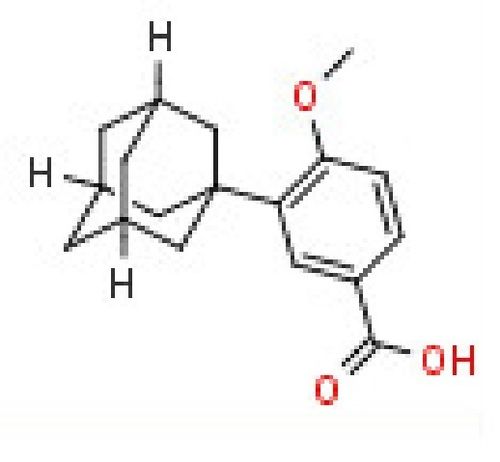
Chemical Name: 3-(1-Adamantyl)-4-methoxybenzoicacid
Synonyms :3-(1-adamantyl)-4-methoxybenzoic acid
| 3-(adamantan-1-yl)-4-methoxybenzoic acid
| 4-methoxy-3-(tricyclo[3.3.1.13,7]dec-1-yl)benzoic acid
Cas No : 104224-62-6
Purity : 95%
MolecularFormula : C18H22O3
Molecular Weight:286.4
Appearance:SolidReliable Laboratory ReagentThis product meets laboratory and analytical grade standards, ensuring it is pure enough for research and synthesis. Its stability, even at elevated temperatures, and its long shelf life make it a trusted choice for academic and industrial laboratories alike.
Applications in Research and SynthesisUsed successfully as an intermediate in organic synthesis, 3-(1-Adamantyl)-4-methoxybenzoic acid is particularly beneficial in medicinal and structural chemistry projects. Its sterically hindered adamantyl group provides structural diversity for new compound development.
Safe Handling and Convenient PackagingThis compound is not classified as hazardous or poisonous under normal laboratory conditions but should be handled according to MSDS guidelines. It is shipped in sealed bottles or aluminum bags, in sizes ranging from 1g to 5g or as required, ensuring safe and protected delivery.
FAQ's of 3-(1-Adamantyl)-4-methoxybenzoic acid:
Q: How should 3-(1-Adamantyl)-4-methoxybenzoic acid be safely stored and handled?
A: Store the compound in a cool, dry place away from moisture and direct light, with the container tightly sealed. Follow standard laboratory safety procedures and consult the MSDS for detailed handling recommendations, even though it is not classified as hazardous under normal conditions.
Q: What are the main uses of 3-(1-Adamantyl)-4-methoxybenzoic acid in research?
A: This compound is primarily used as a building block in organic synthesis, medicinal chemistry research, and structural studies. Its adamantyl group can introduce steric bulk into molecules, enabling the synthesis of novel derivatives for pharmaceutical investigation.
Q: When does this chemical typically decompose, and does it have a standard boiling point?
A: 3-(1-Adamantyl)-4-methoxybenzoic acid does not have a standard boiling point, as it decomposes before reaching boiling. Its melting point is 236-240C, reflecting its strong thermal stability under standard laboratory conditions.
Q: Where can I find analytical data like NMR or MS spectra for this product?
A: Spectral data including 1H NMR, 13C NMR, IR, and mass spectrometry (MS) are available upon request from the supplier or distributor. These resources assist in confirming the identity and purity of the compound for research applications.
Q: What is the typical process for using this compound in synthesis?
A: Researchers dissolve 3-(1-Adamantyl)-4-methoxybenzoic acid in suitable organic solvents such as DMSO or methanol, given its limited water solubility. It is often introduced into reactions requiring aromatic carboxylic acids with enhanced steric hindrance due to the adamantyl moiety.
Q: What are the advantages of selecting this compound for laboratory work?
A: Key benefits include its high purity (>98%), robust thermal and storage stability, and unique adamantyl-based structure. These characteristics make it ideal for precise synthetic applications and in studies where steric modifications are required for bioactive molecule development.






![(9Ar)-octahydro-1h-pyrido[1,2-a]piperazine oxalic acid](https://cpimg.tistatic.com/10014932/b/4/-9Ar-octahydro-1h-pyrido-1-2-a-piperazine-oxalic-acid.jpg?tr=w300)
 Send Inquiry
 Send Inquiry
 Send SMS


