Product Description
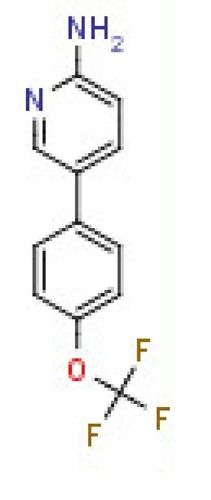
Chemical Name: 2-Amino-5-(4-trifluoromethoxyphenyl)pyridine
Synonyms : 5-[4-(trifluoromethoxy)phenyl]pyridin-2-amine
CAS No : 1110656-38-6
Purity : 98%
Molecular Formula :C12H9F3N2O
Molecular Weight: 254.2
Appearance: Solid
Applications in Synthesis and ResearchThis compound serves as a versatile intermediate for the synthesis of pharmaceuticals, agrochemicals, and other organic compounds. Its high purity and aromatic structure make it ideal for advanced research, chemical synthesis, and as a reference standard. Expert users in R&D settings benefit by leveraging its unique trifluoromethoxy group, facilitating the development of novel molecules.
Safe Handling and Storage2-Amino-5-(4-trifluoromethoxyphenyl) pyridine remains stable when stored between 2-8C in tightly sealed containers, away from light and moisture. Users should avoid contact with strong oxidizers and always handle this compound with appropriate personal protective equipment to avoid skin and eye irritation. Proper storage and handling preserve both quality and safety.
Physical and Chemical PropertiesOff-white to pale yellow in color, this crystalline powder features a molecular formula of C12H8F3N2O and a molecular weight of 252.20 g/mol. It boasts a melting point of 108110C and density of 1.38 g/cm. The substance is characterized by solubility in organic solvents such as DMSO and methanol, but remains insoluble in water, expanding its usage in multiple laboratory environments.
FAQs of 2-Amino-5-(4-trifluoromethoxyphenyl) pyridine:
Q: How should 2-Amino-5-(4-trifluoromethoxyphenyl) pyridine be stored to ensure maximum stability?
A: To maintain optimal stability and a 24-month shelf life, store the compound at 28C in a tightly sealed container, protected from light and moisture. Proper storage will help preserve its purity and prevent degradation.
Q: What are the primary applications of this compound in research and industry?
A: 2-Amino-5-(4-trifluoromethoxyphenyl) pyridine is primarily used as an intermediate in the synthesis of pharmaceuticals and agrochemicals, and for advanced organic synthesis and reference standards in laboratories.
Q: When is it necessary to use personal protective equipment (PPE) with this compound?
A: Appropriate PPE should always be used when handling this compound, as it may cause skin and eye irritation. Gloves, safety goggles, and lab coats are recommended during all handling procedures.
Q: Where is this compound typically utilized within the research process?
A: This compound is frequently incorporated into laboratory settings for research and development, especially where the synthesis of new molecules or analytical referencing in pharmaceuticals and agrochemicals is required.
Q: What solvents are suitable for dissolving this substance during synthesis?
A: The compound dissolves readily in organic solvents like DMSO and methanol but is insoluble in water. These solvents enable flexible applications in diverse organic reactions.
Q: What benefits does this compound offer for chemical synthesis applications?
A: Its high chemical purity (98%), well-defined structure, and trifluoromethoxy substitution provide advantageous reactivity and enhance its suitability for designing complex molecular architectures.






![[2-Amino-1-(2-fluorophenyl)ethyl]dimethylamine 95%](https://cpimg.tistatic.com/09910213/b/4/-2-Amino-1-2-fluorophenyl-ethyl-dimethylamine-95-.jpg?tr=w300)
 Send Inquiry
 Send Inquiry
 Send SMS


