Product Description
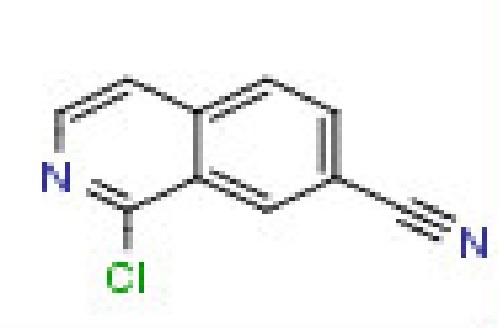
Chemical Name: 1-Chloroisoquinoline-7-carbonitrile
Synonyms : 1-chloroisoquinoline-7-carbonitrile
Cas No : 223671-30-5
Purity : 96%
MolecularFormula : C10H5ClN2
Molecular Weight: 188.6
Appearance: SOLID Superior Stability & Shelf Life1-Chloroisoquinoline-7-carbonitrile is stable under recommended storage conditions, with a shelf life of up to two years. Proper storage in a cool, dry place protects the compound from degradation caused by light and moisture, ensuring it retains its purity and efficacy for extended periods.
Versatile Applications in ResearchThis compound finds extensive use in pharmaceutical research and organic synthesis, acting as a key intermediate in the creation of active pharmaceutical ingredient precursors. Its high purity makes it ideal for analytical, laboratory, and industrial applications, supporting innovation and development in chemical sciences.
Safe Handling and PackagingSafety is prioritized with clearly labeled, securely sealed bottles or vials in sizes ranging from 1g to 25g, as well as custom bulk options. Safety precautions include the use of personal protective equipment, and safe practices to avoid inhalation and contact, ensuring both laboratory and industrial users work with confidence.
FAQ's of 1-Chloroisoquinoline-7- carbonitrile:
Q: How should 1-Chloroisoquinoline-7-carbonitrile be stored to maximize its shelf life?
A: Store the compound in a tightly sealed container at 2-8C, away from light, moisture, and incompatible substances such as strong acids, bases, or oxidizers. These conditions will help maintain its stability and ensure a shelf life of up to two years.
Q: What are the recommended uses and benefits of 1-Chloroisoquinoline-7-carbonitrile?
A: It is primarily utilized as a chemical intermediate in pharmaceutical research and organic synthesis. Its high purity and stability make it advantageous for the production of active pharmaceutical ingredients and for R&D purposes in laboratories.
Q: When should personal protective equipment be used while handling this compound?
A: Always use personal protective equipment, such as gloves, safety goggles, and laboratory coats, when handling 1-Chloroisoquinoline-7-carbonitrile to prevent harmful exposure through skin contact, inhalation, or eye contact.
Q: What is the process for the safe disposal of 1-Chloroisoquinoline-7-carbonitrile?
A: Dispose of the chemical according to local regulations for hazardous laboratory waste. Avoid releasing it into the environment. Consult your institution's waste management protocols or a licensed chemical disposal company.
Q: Where is this compound typically used or applied?
A: It is commonly employed in research laboratories, pharmaceutical development facilities, and chemical manufacturing settings, particularly for its role as a synthesis intermediate and analytical reference standard.
Q: Is 1-Chloroisoquinoline-7-carbonitrile regulated for transportation?
A: According to standard chemical logistics, this compound is not regulated for transportation. However, transport requirements should always be verified for each specific shipment and location.
Q: What are the main physical and chemical properties of 1-Chloroisoquinoline-7-carbonitrile?
A: It is a light yellow to off-white crystalline powder with a melting point of 170-175C, density of 1.34 g/cm3, and a faint aromatic odor. It is insoluble in water but soluble in DMSO and DMF, and is considered harmful if inhaled or in contact with skin.









 Send Inquiry
 Send Inquiry
 Send SMS


