Product Description
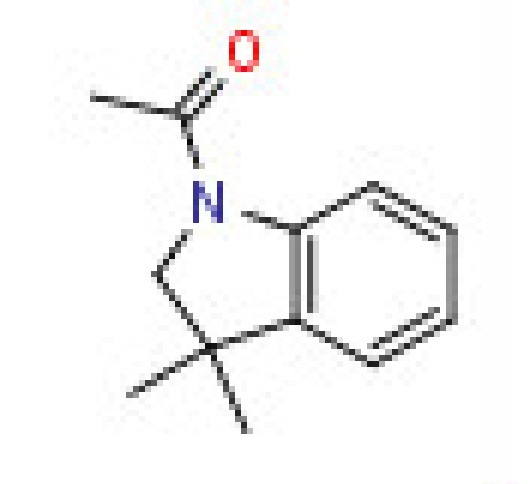
Chemical Name: 1-Acetyl-3,3-dimethylindoline
Synonyms : 1-acetyl-3,3-dimethylindoline
1-(3,3-Dimethylindolin-1-yl)ethanone
1-(3,3-dimethyl-2H-indol-1-yl)ethanone
1H-Indole,1-acetyl-2,3-dihydro-3,3-dimethyl-
CAS No : 16078-32-3
Purity : 98%
MolecularFormula : C12H15NO
Molecular Weight: 189.3
Appearance: SolidApplications in Chemical Synthesis and Research1-Acetyl-3,3-dimethylindoline serves as a versatile intermediate in organic synthesis, particularly within pharmaceutical and medicinal chemistry fields. Researchers use it for constructing heterocyclic frameworks and investigating novel drug candidates. Its high purity and stability make it suitable for a wide range of chemical research applications, from academic studies to industrial projects.
Safe Handling and Storage PracticesThis compound is considered non-hazardous when standard laboratory precautions are followed. Store the product in a tightly sealed container in a cool, dry, well-ventilated area away from strong oxidizing agents. Ensuring proper storage will maintain its quality and stability for up to two years.
Convenient Packaging and Transport1-Acetyl-3,3-dimethylindoline is supplied in sealed amber glass bottles or HDPE containers, protecting it from light and moisture. Its classification as non-dangerous for air, sea, or road transport allows for straightforward delivery to research facilities worldwide. The minimum order quantity is just one gram, making it accessible to laboratories of all sizes.
FAQ's of 1-Acetyl-3, 3-dimethylindoline:
Q: How should 1-Acetyl-3,3-dimethylindoline be stored for optimal shelf life?
A: Store the compound in a cool, dry, and well-ventilated place, tightly closed in its original container. Avoid exposure to strong oxidizing agents to maintain its stability and shelf life of up to two years.
Q: What is the primary usage of 1-Acetyl-3,3-dimethylindoline in laboratories?
A: It is mainly used as an intermediate in organic synthesis, pharmaceuticals, and chemical research, including the creation of heterocyclic compounds and exploration in medicinal chemistry.
Q: When is the compound considered hazardous, and what precautions should be taken?
A: Under normal laboratory conditions, it is non-hazardous. However, standard safety measures such as wearing gloves, goggles, and lab coats should be followed during handling. Heating or exposure to strong oxidizers should be avoided.
Q: Where is this product typically packaged and shipped from, and how is its transport regulated?
A: The compound is supplied and shipped from India, typically packaged in sealed amber glass bottles or HDPE containers. It is not classified as dangerous for transport by air, sea, or road, ensuring hassle-free international delivery.
Q: What benefits does 1-Acetyl-3,3-dimethylindoline offer over similar chemical intermediates?
A: It offers high purity, low volatility, and excellent stability at room temperature. Its versatility in organic synthesis and pharmaceutical research, along with safe handling properties, makes it a preferred choice in research laboratories.
Q: How is the product supplied and what is the minimum order quantity?
A: 1-Acetyl-3,3-dimethylindoline is supplied in sealed glass amber bottles or HDPE containers to ensure stability. The minimum order quantity is one gram.






 Send Inquiry
 Send Inquiry
 Send SMS
 Call Me Free


