Product Description
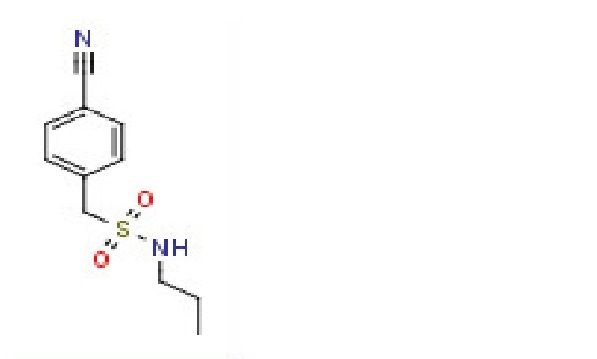
Chemical Name:1-(4-Cyanophenyl)-N-propylmethanesulfonamide
Synonyms : 1-(4-cyanophenyl)-N-propylmethanesulfonamide
CAS No : 923679-46-3
Purity : 97%
MolecularFormula : C11H14N2O2S
Molecular Weight: 238.3
Appearance: SolidSuperior Intermediate for Chemical Synthesis1-(4-Cyanophenyl)-N-propylmethanesulfonamide is widely valued in pharmaceutical and specialty chemical manufacturing for its high purity and chemical stability. With its excellent performance as a synthesis intermediate, users can achieve consistent results in a variety of industrial applications. Its stable, crystalline form supports long shelf life and ease of handling.
Safe and Convenient HandlingThis product is classified as non-hazardous under GHS, is non-poisonous under standard conditions, and does not require special UN regulation. While it does not present a flash point below 230C, standard laboratory precautions-such as using adequate ventilation and avoiding dust inhalation-are recommended for safe use.
Flexible Packaging and Reliable StorageAvailable in multiple packaging options to suit your operational scale, 1-(4-Cyanophenyl)-N-propylmethanesulfonamide remains stable when kept in a cool, dry place at 2-8C. Its durable packaging protects the product integrity, and when properly stored, it maintains its quality for up to two years.
FAQ's of 1-(4-Cyanophenyl)-N- propylmethanesulfonamide:
Q: How should 1-(4-Cyanophenyl)-N-propylmethanesulfonamide be stored to ensure maximum shelf life?
A: Store the chemical in a tightly closed container at 2-8C in a cool, dry place. Proper storage preserves its stability and shelf life, which is up to two years under recommended conditions.
Q: What are the main applications and benefits of using this product?
A: This compound is primarily used as an intermediate in the synthesis of active pharmaceutical ingredients and specialty chemicals, thanks to its high purity and chemical stability, which translate to efficient synthesis processes and consistent product quality.
Q: When is special handling or precaution necessary for this compound?
A: Although not classified as hazardous, it is advisable to work with adequate ventilation and avoid inhaling dust. Standard protective equipment such as gloves and safety glasses is recommended during handling.
Q: Where is this compound typically used or sourced?
A: It is commonly used in pharmaceutical laboratories and chemical manufacturing industries. The product is available from suppliers and traders in India and can be ordered in flexible packaging to meet various industrial needs.
Q: What is the process for using this compound in a chemical synthesis?
A: The product is used as an intermediate, usually dissolved in an appropriate solvent such as DMSO. It can be incorporated into various reaction schemes to build more complex molecules during pharmaceutical or specialty chemical production.
Q: What physical properties make this compound suitable for industrial use?
A: Its high purity (99%), chemical and physical stability, and crystalline structure make it particularly suitable for use in rigorous chemical synthesis environments. It is easy to handle, storages well, and dissolves effectively in DMSO.






![((3-[(Dimethylamino)sulfonyl]benzoyl)amino)acetic acid](https://cpimg.tistatic.com/11320807/b/4/-3-Dimethylamino-sulfonyl-benzoyl-amino-acetic-acid.jpg?tr=w300)
 Send Inquiry
 Send Inquiry
 Send SMS


