Product Description
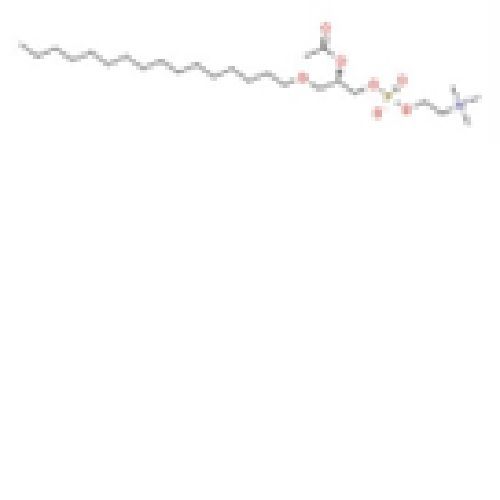
Chemical Name: (R)-2-Acetoxy-3-(hexadecyloxy)propyl(2-(trimethylammonio)ethyl) phosphate
Cas No : 65154-06-5
Purity : 95%
MolecularFormula : C26H54NO7P
Molecular Weight : 523.7Versatile Research Grade Phospholipid AnalogEngineered for advanced biochemical and membrane research, this amphiphilic molecule enables numerous laboratory applications. Its high purity and formulated stability make it ideal for detail-oriented biomembrane studies, surfactant investigations, and custom research protocols.
Safe Handling and Convenient PackagingPackaged in amber glass vials or bottles, (R)-2-Acetoxy-3-(hexadecyloxy)propyl (2-(trimethylammonio)ethyl) phosphate remains stable and easy to handle. Adhering to standard safety practices, users are advised to work with appropriate gloves and eye protection, ensuring safe and effective utilization.
Optimal Storage and Extended Shelf LifeStoring the compound at -20C, protected from moisture and light, preserves its quality for up to 24 months. Its robust stability under these conditions guarantees consistent performance and reliability throughout its shelf life.
FAQ's of (R)-2-Acetoxy-3-(hexadecyloxy)propyl (2-(trimethylammonio)ethyl) phosphate:
Q: How should (R)-2-Acetoxy-3-(hexadecyloxy)propyl (2-(trimethylammonio)ethyl) phosphate be stored for maximum stability?
A: To ensure maximum stability, this compound should be stored at -20C in a tightly sealed container, protected from light and moisture. Amber glass containers are recommended to prevent degradation.
Q: What is the primary usage of this molecule in research settings?
A: This compound is typically used as a phospholipid analog in biomembrane studies, surfactant research, and other advanced biochemical experiments due to its amphiphilic nature and structural similarity to natural phospholipids.
Q: When is it necessary to take extra precautions while handling this product?
A: Extra precautions should be taken during all handling processes-wearing suitable gloves and eye protection is essential, as the product is hygroscopic and may irritate upon contact despite not being classified as hazardous.
Q: Where is this compound commonly utilized?
A: It is commonly utilized in well-equipped research laboratories, academic institutions, or industrial R&D settings, particularly where membrane modeling, surfactant testing, or biochemical analysis is conducted.
Q: What benefits does this phospholipid analog offer for biochemical research?
A: Its high purity, amphiphilic character, and well-defined stability profile allow for reproducible results in research, making it a reliable choice for studying membrane dynamics and surfactant behavior.
Q: How is this product typically formulated and supplied?
A: The compound is supplied neat or dissolved in a customer-specified solvent, packaged in amber glass vials or bottles to maintain integrity during transport and storage.
Q: What process should be followed if decomposition is suspected?
A: If decomposition is suspected (e.g., exposure to temperatures above 200C), the material should be safely discarded according to laboratory protocols. Avoid inhaling or direct contact with decomposition products and ensure appropriate waste management.






![(3As,5r,6s,6as)-6-hydroxy-2,2-dimethyltetrahydrofuro[2,3-d][1,3]dioxole-5-carboxylic acid Synonyms : (3aS,5R,6S,6aS)-6-hydroxy-2,2-dimethyltetrahydrofuro[2,3-d][1,3]dioxole-5-carboxylic acid](https://cpimg.tistatic.com/10021181/b/4/-3As-5r-6s-6as-6-hydroxy-2-2-dimethyltetrahydrofuro-2-3-d-1-3-dioxole-5-carboxylic-acid-Synonyms-3aS-5R-6S-6aS-6-hydroxy-2-2-dimethyltetrahydrofuro-2-3-d-1-3-dioxole-5-carboxylic-acid.jpg?tr=w300)
 Send Inquiry
 Send Inquiry
 Send SMS
 Call Me Free


