Product Description
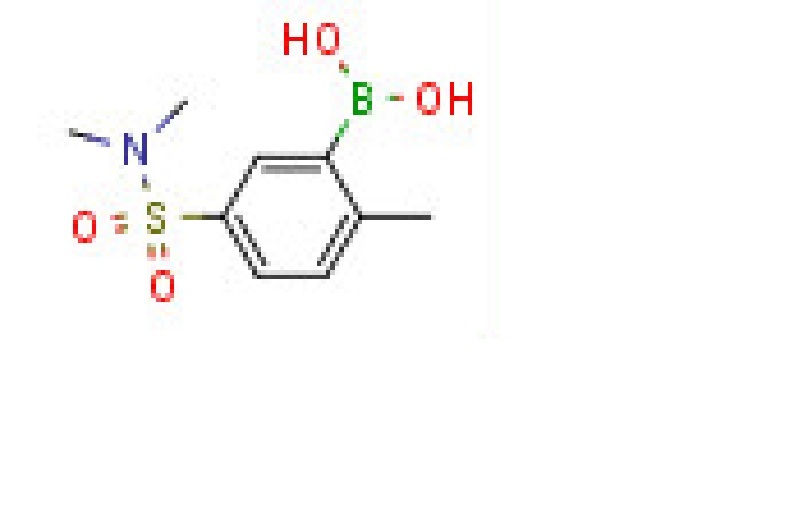
Chemical Name: N,N-Dimethyl3-borono-4-methylbenzenesulfonamide
Synonyms : 5-(N,N-Dimethylsulfamoyl)-2-methylphenylboronicacid
CAS No : 871332-99-9
Purity : 98%
MolecularFormula : C9H14BNO4S
Molecular Weight:243.1
Appearance : SolidA Versatile Building Block for SynthesisN,N-Dimethyl 3-borono-4-methylbenzenesulfonamide is valued for its unique combination of boronic acid and sulfonamide functional groups, making it a sought-after reagent in medicinal chemistry and organic synthesis. Its stability and high purity facilitate its use in complex transformations.
Safe Handling and Storage RecommendationsWhile the compound is classified as having low toxicity, laboratory standard safety protocols should be followed due to the potential for mild eye and skin irritation. It should be stored tightly closed, protected from moisture, and kept in a cool, dry place to ensure maximum shelf life of up to 24 months.
Applications and Benefits in ResearchThis sulfonamide is instrumental in drug research and serves as a critical reactant in Suzuki coupling and related chemical reactions. Its reliable reactivity, solubility in DMSO, and crystalline nature streamline synthetic processes and contribute to reproducible results in laboratory and industrial settings.
FAQ's of N,N-Dimethyl 3-borono-4-methylbenzenesulfonamide:
Q: How should N,N-Dimethyl 3-borono-4-methylbenzenesulfonamide be stored to maintain its stability?
A: It should be kept tightly closed in a cool, dry place, protected from moisture, to ensure its stability and preserve its shelf life of 24 months.
Q: What are the primary uses of this compound in laboratory and industrial settings?
A: The compound is mainly used as a boronic acid reagent in organic synthesis, for drug research, Suzuki coupling reactions, and as a building block for pharmaceutical intermediates.
Q: When should I consider using this product in my synthesis?
A: Use this compound when your research or synthesis requires a stable organoboron sulfonamide, particularly for boronic acid-mediated reactions or in the construction of complex organic molecules.
Q: Where is this compound typically applied in the pharmaceutical field?
A: It is widely used in medicinal chemistry as a precursor for drug research and development, aiding the creation of novel molecules for therapeutic applications.
Q: What safety measures are recommended during handling?
A: Although it has low toxicity, wearing appropriate lab gloves, goggles, and protective clothing is advised to avoid mild eye or skin irritation during handling.
Q: How is the compound supplied and what packaging sizes are available?
A: It is supplied as a crystalline powder in packaging sizes of 1 g, 5 g, 10 g, or as per specific requests to accommodate laboratory or industrial requirements.
Q: What are the benefits of using this compound for research?
A: Its high purity, stability, and dual functional groups enhance reliability in complex transformations, making it a valuable tool for efficient synthesis in research applications.






![N'-[(4-Cyanobenzene)sulfonyl]-N,N- dimethylmethanimidamide](https://cpimg.tistatic.com/10766922/b/4/N-4-Cyanobenzene-sulfonyl-N-N-dimethylmethanimidamide.jpg?tr=w300)
 Send Inquiry
 Send Inquiry
 Send SMS
 Call Me Free


