Product Description
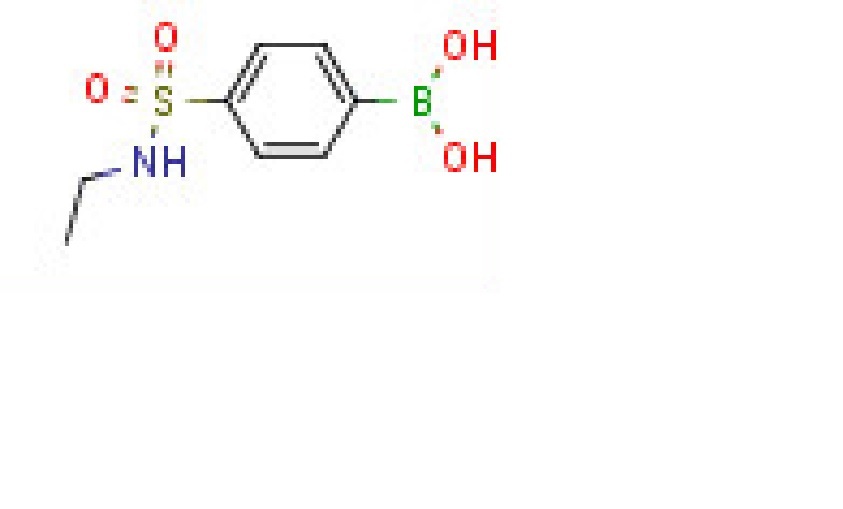
Chemical Name: N-Ethyl4-boronobenzenesulfonamide
Synonyms :4-N-Ethylsulfamoylphenylboronicacid
CAS No : 871329-65-6
Purity : 98%
MolecularFormula : C8H12BNO4S
Molecular Weight:229.1
Appearance : SolidKey Features and ApplicationsN-Ethyl 4-boronobenzenesulfonamide serves as a versatile building block in pharmaceutical and boron chemistry. Its main applications include use as an intermediate in organic synthesis and in Suzuki-Miyaura cross-coupling for constructing complex molecules. The compound's high purity and stability make it suitable for research and laboratory purposes.
Safe Handling and StorageThis compound is stable when stored in a cool, dry place with the container tightly closed. No specific hazardous phrases are associated with it, and it is not classified under any UN hazard category. Appropriate storage prolongs its shelf life, ensuring consistent results in laboratory and research usage.
FAQ's of N-Ethyl 4-boronobenzenesulfonamide:
Q: How should N-Ethyl 4-boronobenzenesulfonamide be stored to maintain stability?
A: To ensure optimal stability, N-Ethyl 4-boronobenzenesulfonamide should be stored in a cool, dry location, with the container kept tightly closed. Following these storage conditions helps maintain product quality throughout its 24-month shelf life.
Q: What are the main uses of N-Ethyl 4-boronobenzenesulfonamide in research and industry?
A: This compound is predominantly utilized as an intermediate in pharmaceutical manufacturing and organic synthesis, particularly in Suzuki-Miyaura coupling reactions, which are essential for constructing complex chemical structures.
Q: When should I use N-Ethyl 4-boronobenzenesulfonamide over other boronic acids in synthesis?
A: You should use N-Ethyl 4-boronobenzenesulfonamide when you require a sulfonamide and ethyl-substituted organoboron compound for precision applications, such as in the synthesis of pharmaceutical intermediates or when its specific structural attributes enhance reactivity or selectivity.
Q: Where is this compound most commonly applied in the scientific field?
A: It finds significant application in laboratory and research settings focused on organic synthesis, medicinal chemistry, and drug discovery, especially for teams utilizing advanced cross-coupling methodologies.
Q: What is the process for using this compound in Suzuki-Miyaura coupling reactions?
A: In Suzuki-Miyaura coupling, N-Ethyl 4-boronobenzenesulfonamide acts as the boron-containing reagent, reacting with halogenated aromatic compounds in the presence of a palladium catalyst to form carbon-carbon bonds. It is typically dissolved in DMSO due to its good solubility in this solvent.
Q: What benefits does N-Ethyl 4-boronobenzenesulfonamide offer over standard boronic acids?
A: This compound provides the advantage of a unique sulfonamide and ethyl substitution, increasing versatility in reactions and allowing for the synthesis of otherwise challenging molecules in pharmaceutical research.






![3-[({2-[(Diaminomethylidene)amino]-1,3-thiazol-4-yl}methyl)sulfanyl]-N- sulfamoylpropanimidamid](https://cpimg.tistatic.com/10878476/b/4/3-2-Diaminomethylidene-amino-1-3-thiazol-4-yl-methyl-sulfanyl-N-sulfamoylpropanimidamid.jpg?tr=w300)
 Send Inquiry
 Send Inquiry
 Send SMS


