Product Description
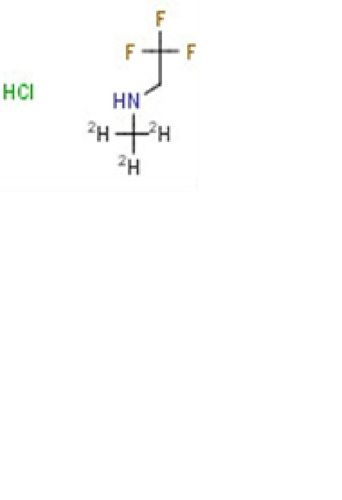
Chemical Name: Methyl-d3(2,2,2-trifluoroethyl)amine hydrochloride
Synonyms : 2,2,2-trifluoro-N-(trideuteriomethyl)ethanamine;hydrochloride
Cas No : 2222512-13-0
Purity : 95%
MolecularFormula : C3H7ClF3N
Molecular Weight: 152.6
Exceptional Isotopic Labeling for ResearchThis compound boasts over 98% deuterium content, making it ideal for isotope labeling applications in pharmaceutical and NMR spectroscopy research. Its high purity and reliability ensure accuracy in sensitive studies where isotopic distinction is critical. The unique trifluoroethyl structure allows for versatile integration into various synthetic and analytical protocols.
Safe and Convenient Packaging OptionsMethyl-d3 (2,2,2-trifluoroethyl)amine hydrochloride is supplied in customizable packaging, including a common 1g size, to meet diverse research needs. Its stability is maintained by proper storage at 2-8C away from moisture. Although not classified as hazardous, standard laboratory safety practicessuch as wearing gloves and protective eyewearare recommended during handling.
FAQs of Methyl-d3 (2,2,2-trifluoroethyl)amine hydrochloride:
Q: How should Methyl-d3 (2,2,2-trifluoroethyl)amine hydrochloride be stored to maintain its quality?
A: Store this compound at 2-8C in tightly sealed packaging, protected from moisture, to ensure its shelf stability and maintain purity. Minimize exposure to air and humidity for best results.
Q: What is the primary use of Methyl-d3 (2,2,2-trifluoroethyl)amine hydrochloride in research?
A: This compound is mainly used for isotope labeling studies, NMR spectroscopy, and as a reagent or intermediate in pharmaceutical research, thanks to its high deuterium content and chemical purity.
Q: When does this compound typically expire, and how is shelf life determined?
A: The shelf life of Methyl-d3 (2,2,2-trifluoroethyl)amine hydrochloride is 12 months when stored properly in a cool, dry environment as recommended. This period ensures stable physical and chemical properties for research use.
Q: Where can this compound be sourced, and what packaging sizes are available?
A: This product is available through laboratory suppliers and traders in India. Custom packaging is offered, with a common size of 1 gram to accommodate various research requirements.
Q: What identification methods are recommended to confirm the purity of this compound?
A: 1H NMR and mass spectrometry are the preferred techniques for identifying and confirming the isotopic and chemical purity of this substance, ensuring it meets laboratory-grade standards.
Q: How should researchers handle this compound to ensure safety and product integrity?
A: Always handle the powder under dry conditions, using gloves and protective eyewear. Although not classified as hazardous, proper laboratory safety practices help avoid contamination and exposure to environmental moisture.
Q: What benefits does the high deuterium enrichment offer in scientific applications?
A: The high deuterium content enhances the compounds effectiveness in labeling studies and tracer experiments, providing improved sensitivity and accuracy in analytical and pharmaceutical research.






 Send Inquiry
 Send Inquiry
 Send SMS
 Call Me Free


