Product Description
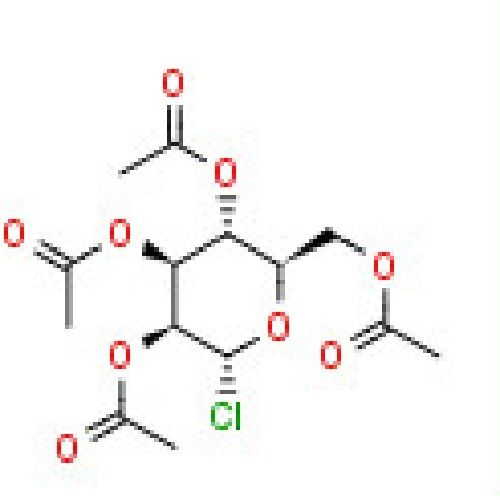
Chemical Name: Acetochloro-alpha-d-mannose
Synonyms :2,3,4,6-Tetra-O-acetyl-a-D-mannopyranosylchloride
|2,3,4,6-Tetra-O-acetyl-alpha-D-mannopyranosylchloride
(2R,3R,4S,5S,6R)-3,4,5-triacetyloxy-6-chlorooxan-2-yl]methylacetate
|(2R,3R,4S,5S,6R)-2-(Acetoxymethyl)-6-chlorotetrahydro-2H-pyran-|3,4,5-triyltriacetate
|Acetochloro-a-D-mannose
|Acetochloro-alpha -D-mannose
Cas No : 14257-40-0
Purity : 97%
MolecularFormula : C14H19ClO9
Molecular Weight: 366.7
Appearance: SolidHigh Stability and PurityAcetochloro--D-mannose is produced to laboratory grade standards and features a high purity level above 98%. Its stability is preserved for up to 2 years when the product remains unopened and stored at a cool, dry temperature between 2-8C, away from moisture and light.
Versatile Application in ResearchThis compound is widely used as a precursor in glycosylation reactions, making it essential for biochemical research and carbohydrate chemistry. Its solubility in common organic solvents increases its utility in diverse experimental settings.
Convenient and Safe HandlingPackaged in moisture-resistant containers and classified as non-hazardous for transport and regular handling, Acetochloro--D-mannose is easy to manage in standard laboratory environments. It remains non-poisonous and odorless, supporting safe and convenient use.
FAQ's of Acetochloro - alpha- d- mannose:
Q: How should Acetochloro--D-mannose be stored for optimal stability?
A: Store Acetochloro--D-mannose in a tightly closed, moisture-resistant container at 2-8C in a cool, dry place away from light. Proper storage ensures the compound remains stable and effective for up to 24 months.
Q: What are the typical uses of Acetochloro--D-mannose in the laboratory?
A: Acetochloro--D-mannose is commonly used as a precursor and intermediate in glycosylation reactions, vital for carbohydrate chemistry and various biochemical research applications.
Q: When does Acetochloro--D-mannose decompose and how should this be considered during use?
A: This compound decomposes before boiling and should not be subjected to excessive heat. Standard laboratory processes maintain temperatures below its decomposition range (120-124C), ensuring its integrity during typical use.
Q: Where is Acetochloro--D-mannose typically applied or utilized?
A: It is primarily utilized in research laboratories, particularly in the synthesis and analysis of carbohydrate derivatives. Its compatibility with most organic solvents enhances its versatility in multiple research protocols.
Q: What benefits does Acetochloro--D-mannose offer for synthetic procedures?
A: Its high purity, alpha anomeric chirality, and solubility in water, methanol, and DMSO allow for efficient incorporation into synthetic pathways, improving yields and reproducibility in glycosylation and other chemical reactions.
Q: Is Acetochloro--D-mannose hazardous or regulated for transportation?
A: No, Acetochloro--D-mannose is considered non-hazardous under normal handling and is not regulated as dangerous goods for transport according to current guidelines.






![6-([(3-Acetylphenyl)amino]carbonyl)cyclohex-3-ene-1-carboxylic acid](https://cpimg.tistatic.com/09675150/b/4/6-3-Acetylphenyl-amino-carbonyl-cyclohex-3-ene-1-carboxylic-acid.jpg?tr=w300)
![6-([(4-Acetylphenyl)amino]carbonyl)cyclohex-3-ene-1-carboxylic acid](https://cpimg.tistatic.com/09675259/b/4/6-4-Acetylphenyl-amino-carbonyl-cyclohex-3-ene-1-carboxylic-acid.jpg?tr=w300)
 Send Inquiry
 Send Inquiry
 Send SMS


