Product Description
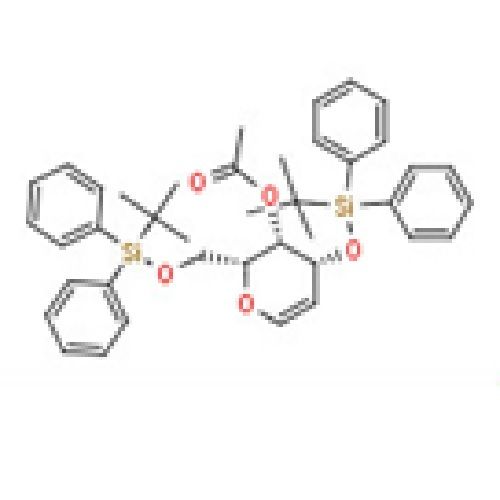
Chemical Name: 4-O-Acetyl-3,6-di-o-(tert-butyldiphenylsilyl)-d-galactal
Synonyms :4-O-Acetyl-3,6-di-O-(tert-butyldiphenylsilyl)-D-galactal
| (2R,3S,4R)-4-((tert-Butyldiphenylsilyl)oxy)-2-(((tert-butyldiphenylsilyl)oxy)methyl)-3,4-dihydro-2H-pyran-3-ylacetate
(2R,3S,4R)-4-[tert-butyl(diphenyl)silyl]oxy-2-tert-butyl(diphenyl)silyl]oxymethyl]-3,4-dihydro-2H-pyran-3-yl]acetate
Cas No : 342029-19-0
Purity : 95%
MolecularFormula : C40H48O5Si2
Molecular Weight :665.0Advanced Silyl-Protected Galactal for Organic Synthesis4-O-Acetyl-3,6-di-O-(tert-butyldiphenylsilyl)-D-galactal offers a reliable protected galactal core, tailored for researchers in carbohydrate chemistry. Its orthogonal protection with tert-butyldiphenylsilyl and acetyl groups enables selective functionalization and streamlined synthesis routes in complex oligosaccharide assembly. High enantiomeric and chemical purity ensure dependable results, making it a go-to intermediate for both academic and industrial applications. This material's robust protection supports nuanced synthetic strategies.
Proper Handling and Storage Ensures StabilityTo maintain the stability and purity of this compound, store it at 2-8C in a sealed amber glass bottle, shielded from light and moisture. The product decomposes before boiling, so avoid heating and exposure to strong acids or bases. Standard laboratory procedures are sufficient as it is not classified as hazardous. When handled and stored correctly, the compound's quality and shelf life-up to two years-are preserved, supporting reliable outcomes in research projects.
Convenient Packaging and Safe TransportationSupplied in typical amounts of 100 mg or 500 mg, this compound is packaged in sealed amber glass bottles to safeguard against moisture and light. It is recognized as non-dangerous goods for transportation under IATA, IMDG, and ADR regulations, ensuring smooth global distribution. Researchers can confidently order the compound from specialty traders, particularly in India, without concerns over regulatory impediments or special handling requirements during shipping.
FAQ's of 4-O-Acetyl-3,6-di-o-(tert-butyldiphenylsilyl)-d- galactal:
Q: How should 4-O-Acetyl-3,6-di-O-(tert-butyldiphenylsilyl)-D-galactal be stored for optimal stability?
A: For best results, store the compound between 2-8C in a tightly sealed amber glass bottle. Ensure it is protected from moisture and light to maintain its chemical integrity and shelf life of up to two years.
Q: What are the primary research applications and benefits of using this protected galactal?
A: This compound serves as a versatile intermediate in the synthesis of oligosaccharides and in carbohydrate chemistry studies. Its silyl and acetyl protective groups allow for selective functionalization and orthogonal deprotection, facilitating precise synthetic strategies.
Q: When is it appropriate to use this compound in an organic synthesis workflow?
A: Use this compound during stages of your synthesis that require the protected D-galactal core, particularly in multi-step oligosaccharide assembly, where moisture and acid/base sensitive intermediates are handled, ensuring their selective transformation.
Q: Where can I purchase this product and in what quantities is it typically available?
A: This monosaccharide derivative can be sourced from specialty organic chemical vendors and research suppliers, often available in 100 mg or 500 mg quantities, particularly from traders based in India.
Q: What precautions should be taken during handling and usage in the laboratory?
A: Though not classified as hazardous, it is sensitive to moisture, light, strong acids, and bases. Always handle it using standard laboratory protective precautions, and work under inert atmosphere or desiccated conditions when necessary.
Q: How is this compound typically used in practice, and what solvents can dissolve it?
A: Researchers use it as a protected building block for constructing complex saccharides. It dissolves in chloroform, dichloromethane, and similar organic solvents, but is insoluble in water, which makes it suitable for organic-phase reactions.






![2-Aza-bicyclo[2.2.1]heptane-2,6-dicarboxylic acid 2-tert-butyl ester](https://cpimg.tistatic.com/10032586/b/4/2-Aza-bicyclo-2-2-1-heptane-2-6-dicarboxylic-acid-2-tert-butyl-ester.jpg?tr=w300)
 Send Inquiry
 Send Inquiry
 Send SMS
 Call Me Free


