Product Description
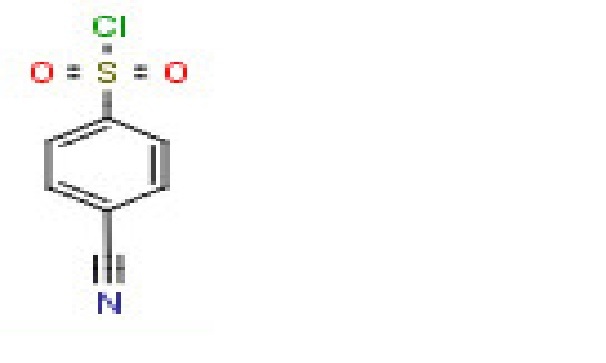
4-Cyanobenzenesulfonylchloride
Synonyms : 4-cyanobenzene-1-sulfonyl chloride
4-cyanobenzenesulfonylchloride
CAS No : 49584-26-1
Purity : 98%
MolecularFormula : C7H4ClNO2S
Molecular Weight: 201.6
Appearance: SolidKey Features and PropertiesThis sulfonyl chloride displays a crystalline appearance and is distinguished by its high purity and reactivity. With a melting point of 92-96C and a density of 1.48 g/cm3, it decomposes in water but dissolves in several organic solvents, making it useful for various synthetic applications. Its pungent characteristic odor, combined with corrosive and irritant hazards, necessitates careful storage and handling.
Safe Handling and StorageThe product is stable when stored as recommended: keep it tightly sealed in HDPE containers, in a cool, dry, and well-ventilated area. As it is sensitive to moisture and decomposes to toxic gases when heated, always use appropriate personal protective equipment and avoid exposure to skin and eyes. Training in chemical handling and emergency procedures is advised for all users.
Applications and UsagePrimarily, 4-Cyanobenzenesulfonyl chloride serves as an intermediate or reagent in chemical industries, notably within pharmaceutical, agrochemical, and dye synthesis. Its utility in sulfonylation processes enables the creation of valuable compounds and active pharmaceutical ingredients, providing versatility and efficiency in advanced organic synthesis.
FAQ's of 4-Cyanobenzenesulfonyl chloride:
Q: How should 4-Cyanobenzenesulfonyl chloride be stored to maintain stability?
A: Store the compound in tightly sealed HDPE drums, in a cool, dry, and well-ventilated area, away from sources of moisture and heat to preserve its stability and prolong shelf life to up to two years.
Q: What precautions are necessary when handling this chemical?
A: Always use personal protective equipment such as gloves, goggles, and protective clothing. Avoid direct contact with skin and eyes, and handle the substance in a well-ventilated space to prevent inhalation or accidental exposure.
Q: Where is 4-Cyanobenzenesulfonyl chloride typically applied?
A: This reagent is widely used as an intermediate in the production of pharmaceuticals, agrochemicals, and dyes, owing to its reactivity and compatibility in sulfonylation reactions during organic synthesis.
Q: What are the benefits of using 4-Cyanobenzenesulfonyl chloride in organic synthesis?
A: It offers high purity and reactivity, facilitating efficient sulfonylation reactions. This makes it valuable in synthesizing active pharmaceutical ingredients and specialty chemicals with enhanced yield and selectivity.
Q: How is this chemical transported and packaged safely?
A: For transportation, it is classified as a Class 8 (corrosive) good under UN 3261, Packing Group II. It is packaged in tightly sealed HDPE drums to prevent exposure to air and moisture, in compliance with international transport regulations.
Q: What hazards are associated with this compound and how can they be mitigated?
A: 4-Cyanobenzenesulfonyl chloride is corrosive, irritating, and poisonous. Exposure can cause severe burns or respiratory problems; proper handling, personal protective equipment, and access to emergency shower/eyewash facilities are essential for risk mitigation.
Q: What happens if the compound is exposed to water or heated above its melting point?
A: Exposure to water causes decomposition, while heating above its melting point leads to breakdown and release of toxic gases. Avoid both conditions to ensure operational safety and maintain product integrity.






![2-[(1,1-Dioxido-1,2-benzisothiazol-3-yl)amino]-3-methylbutanoic acid](https://cpimg.tistatic.com/11559587/b/4/2-1-1-Dioxido-1-2-benzisothiazol-3-yl-amino-3-methylbutanoic-acid.jpg?tr=w300)
![[4-(diethylsulfamoyl)-3-methylphenyl]boronic acid](https://cpimg.tistatic.com/11186403/b/4/-4-diethylsulfamoyl-3-methylphenyl-boronic-acid.jpg?tr=w300)
 Send Inquiry
 Send Inquiry
 Send SMS
 Call Me Free


