Product Description
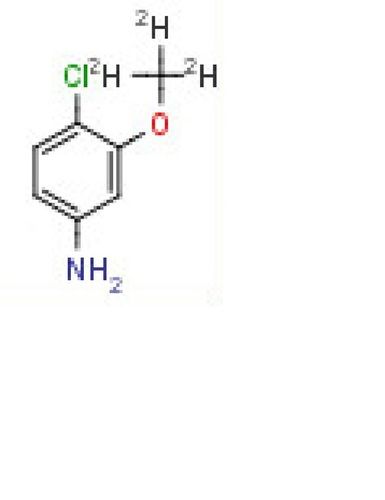
Chemical Name: 4-Chloro-3-(methoxy-d3)aniline
Synonyms : 4-Chloro-3-(trideuteriomethoxy)aniline
Cas No : 2140305-82-2
Purity : 95%
MolecularFormula : C7H8ClNO
Molecular Weight: 160.6
High Deuterium Purity for Research ApplicationsThis compound offers over 99% deuterium content on its methoxy group, making it ideal for precise isotope labeling and mechanistic studies. Its high purity (98%) and stability under laboratory conditions ensure reliability in analytical and pharmaceutical research. Supplied in different quantities, it meets the demands of various scientific projects requiring detailed isotopic analysis.
Safe Handling and Storage Guidelines4-Chloro-3-(methoxy-d3) aniline should be handled in a fume hood with proper personal protective equipment such as gloves, safety goggles, and lab coats. Store the sealed amber glass bottles in a cool, dry place away from light and moisture to preserve its quality and longevity. Following these practices maintains product performance and laboratory safety.
FAQ's of 4-Chloro-3-(methoxy-d3) aniline:
Q: How should 4-Chloro-3-(methoxy-d3) aniline be handled and stored in the laboratory?
A: Use gloves, eye protection, and a lab coat, and always handle it in a well-ventilated fume hood. Store the compound in tightly closed amber glass bottles in a cool, dry area away from light and moisture to preserve its stability and effectiveness.
Q: What is the primary benefit of using 4-Chloro-3-(methoxy-d3) aniline in research?
A: The high deuterium enrichment (>99 atom % D3 on the methoxy group) is particularly valuable for mechanistic studies and isotope labeling, enabling precise tracing in chemical and pharmaceutical research applications.
Q: When does 4-Chloro-3-(methoxy-d3) aniline expire?
A: Under recommended storage conditions, the product maintains a shelf life of 24 months from the date of packaging.
Q: Where is this compound typically applied or used?
A: It is primarily used in pharmaceutical research, isotope labeling, mechanistic studies, and analytical synthesis in laboratory settings. It is not intended for human or veterinary use.
Q: What is the recommended process for disposing of this compound?
A: Dispose of unused or waste material following institutional chemical waste guidelines and local regulations for hazardous substances. Consult your laboratory's safety officer for detailed procedures.
Q: Why is the product supplied in amber glass bottles?
A: Amber glass bottles protect the compound from light exposure, which helps maintain its stability and prevents degradation, especially important for deuterium-labeled materials.






 Send Inquiry
 Send Inquiry
 Send SMS


