Product Description
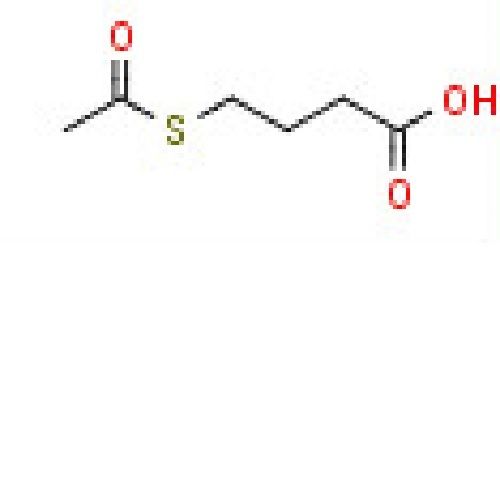
Chemical Name: 4-(Acetylsulfanyl)butanoicacid
Synonyms :Butanoic acid, 4-(acetylthio)-
| 4-(Acetylsulfanyl)butanoic acid
| 4-acetylsulfanylbutanoic acid
Cas No : 101421-82-3
Purity : 95%
MolecularFormula : C6H10O3S
Molecular Weight :162.2Versatile Chemical Intermediate4-(Acetylsulfanyl)butanoic acid serves as a valuable intermediate in organic synthesis and the development of pharmaceutical compounds. Its dual functional groups-carboxylic acid and thioester-make it adaptable for a variety of chemical transformations, providing significant flexibility for research and synthesis in laboratory settings.
Safe and Stable HandlingThis compound is labeled as non-hazardous for standard handling and transport, ensuring safety during storage and use. While it is stable when handled as recommended, users should wear suitable protective clothing and gloves. Its decomposition before boiling makes correct handling essential for safe laboratory practice.
Convenient Packaging and StorageAvailable in 25g, 100g, and 500g bottles, 4-(Acetylsulfanyl)butanoic acid is easy to store and access as needed. For optimal shelf life, keep containers tightly sealed in cool, dry places. Proper storage maintains its integrity for up to two years in the original packaging.
FAQ's of 4-(Acetylsulfanyl)butanoic acid:
Q: How should 4-(Acetylsulfanyl)butanoic acid be stored for maximum shelf life?
A: Store the product tightly sealed in a cool, dry environment. Under these conditions and in its original packaging, it remains stable and retains its quality for up to two years.
Q: What are the primary uses of 4-(Acetylsulfanyl)butanoic acid?
A: It is most commonly used as an intermediate in organic synthesis and pharmaceutical development, assisting in the preparation of complex molecules and active pharmaceutical ingredients.
Q: When does the product decompose and what is its flash point?
A: 4-(Acetylsulfanyl)butanoic acid decomposes before reaching its boiling point and has a flash point greater than 110C, ensuring stability for most laboratory applications.
Q: Where is this compound typically utilized?
A: The compound finds application in laboratory and research facilities engaged in organic synthesis, medicinal chemistry, and the preparation of various organic intermediates, particularly in India.
Q: What precautions should be taken during handling?
A: Although classified as non-hazardous and non-poisonous, it is advisable to handle the compound with appropriate protective gear, including gloves and safety clothing, especially during laboratory procedures.
Q: What are the benefits of using this product in synthesis?
A: Its dual functionality from the carboxylic acid and thioester groups enables a wide range of chemical modifications, making it especially valuable for versatile synthetic applications.






 Send Inquiry
 Send Inquiry
 Send SMS
 Call Me Free


