Product Description
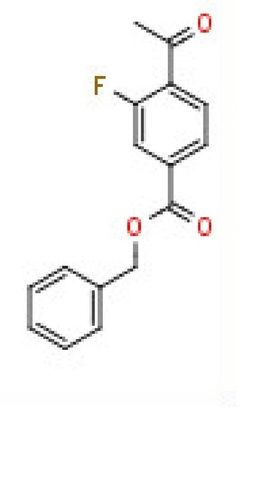
Chemical Name: 4-Acetyl-3-fluoro-benzoicacid benzyl ester
Synonyms : Benzyl4-acetyl-3-fluorobenzoate |
4-Acetyl-3-fluorobenzoicacid benzyl ester
CAS No : 2270905-99-0
Purity : 95%
Molecular Formula: C16H13FO3
Molecular Weight: 272.3
Appearance: Solid
High-Purity Analytical Reagent for ResearchThis compound is specifically synthesized for laboratory and R&D use, often in the development and synthesis of pharmaceuticals. Its stable, crystalline nature and high purity ensure reliable results, making it an ideal reagent for a variety of chemical transformations or as a building block in complex organic synthesis.
Safe Handling, Storage, and PackagingPackaged in sealed HDPE bottles, the compound remains protected from moisture and contaminants. It should be stored at ambient temperature, in a cool, dry place, and out of direct sunlight to maintain its integrity and extend its shelf life up to two years.
FAQs of 4-Acetyl-3-fluoro-benzoic acid benzyl ester:
Q: How should 4-Acetyl-3-fluoro-benzoic acid benzyl ester be handled and stored for optimal stability?
A: Handle this compound according to the Material Safety Data Sheet (MSDS). Store in a tightly sealed container, in a cool, dry place, and avoid direct sunlight. These practices ensure stability and extend its shelf life to two years.
Q: What are the typical uses of this compound in the laboratory setting?
A: It is primarily used as an intermediate in organic synthesis and pharmaceutical research and development. The compounds high purity and solubility in organic solvents make it suitable for complex organic syntheses and chemical transformations.
Q: When does the compound start to decompose, and what precautions should be taken during heating?
A: The compound decomposes before boiling, with a decomposition temperature above 120C and a flash point over 110C. Avoid excessive heating to prevent decomposition or hazardous by-products during experimental procedures.
Q: Where is this product commonly applied or beneficial for researchers?
A: Researchers in organic and medicinal chemistry benefit from this compound as it serves as a key intermediate in the synthesis of pharmaceuticals and complex organic molecules, supporting new drug development and various academic investigations.
Q: What process is used for packaging this compound, and in what sizes is it available?
A: It is supplied in sealed HDPE (high-density polyethylene) bottles to protect the compound from moisture and contamination. Packaging sizes offered include 1g, 5g, and 10g units.
Q: How does the purity and physical form of the compound aid in research and development?
A: With a purity of 98% or greater and a crystalline, off-white solid form, this compound supports high-precision research. Its consistency ensures reproducibility in experimental results, a critical factor in laboratory-scale synthesis and R&D.






![[(3S,4R)-1-Benzyl-4-(3-fluorophenyl)pyrrolidin-3-yl] methanol](https://cpimg.tistatic.com/10147716/b/4/-3S-4R-1-Benzyl-4-3-fluorophenyl-pyrrolidin-3-yl-methanol.jpg?tr=w300)
 Send Inquiry
 Send Inquiry
 Send SMS
 Call Me Free


