Product Description
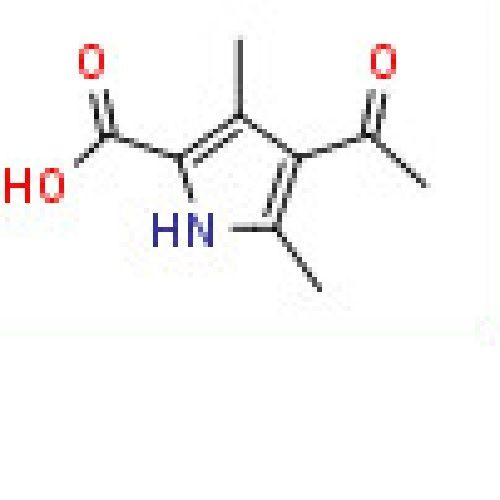
Chemical Name: 4-Acetyl-3,5-dimethyl-1h-pyrrole-2-carboxylicacid
Synonyms :4-Acetyl-3,5-dimethyl-1H-pyrrole-2-carboxylic acid
4-Acetyl-3,5-dimethyl-2-pyrrolecarboxylic acid
1H-Pyrrole-2-carboxylic acid, 4-acetyl-3,5-dimethyl-
Cas No : 2386-28-9
Purity : 95%
MolecularFormula : C9H11NO3
Molecular Weight :181.2Key Physical and Chemical PropertiesThis compound is recognized for its crystalline shape, melting point between 193-198C, and density of 1.36 g/cm3. Although its boiling point is undetermined due to decomposition, it remains stable under normal laboratory conditions. Sensitivity to light requires careful storage, while its partial solubility in water and complete solubility in various organic solvents make it versatile for research applications.
Applications in Research and IndustryWidely used as a pharmaceutical intermediate and in chemical synthesis, this compound serves as an essential reagent for organic synthesis and studies in research laboratories. It supports method development and the creation of novel compounds, enhancing innovation in chemical and pharmaceutical sectors. High purity ensures consistent and reliable experimental outcomes.
Safe Handling and StorageThe substance should be handled with care, avoiding contact with eyes, skin, or clothing. It should be stored at ambient temperatures, in a cool, dry place inside sealed containers or glass bottles, protected from light and moisture. Under these recommended conditions, it exhibits a shelf life of up to two years, maintaining its stability and integrity throughout.
FAQ's of 4-Acetyl-3,5-dimethyl-1h-pyrrole-2-carboxylic acid:
Q: How should 4-Acetyl-3,5-dimethyl-1h-pyrrole-2-carboxylic acid be stored for maximum shelf life?
A: Store the compound in tightly sealed containers or glass bottles at ambient temperature, protected from moisture and sunlight. This approach safeguards its stability and preserves quality for up to two years.
Q: What are the primary uses of this compound in laboratory settings?
A: It is commonly used as a building block in organic synthesis, pharmaceutical intermediate, and chemical research. Its high purity and reactivity make it ideal for developing new compounds and methods.
Q: When does handling this substance require extra precautions?
A: Even though it is not classified as hazardous, precautions are necessary to avoid eye, skin, and clothing contact. Basic personal protective equipment is recommended during handling and transfer.
Q: Where can 4-Acetyl-3,5-dimethyl-1h-pyrrole-2-carboxylic acid be safely transported?
A: It is not classified as a dangerous good for transport and can be shipped following standard procedures, provided it remains securely packed to prevent exposure to environmental factors.
Q: What process is recommended for dissolving this compound for experimental use?
A: The compound dissolves readily in organic solvents such as methanol, ethanol, or DMSO, and is partially soluble in water. Select the solvent based on your experimental requirements and solubility needs.
Q: What are the benefits of using this compound in research and synthesis?
A: Its high purity (98%) and consistent chemical properties make it a reliable reagent for reproducible results in organic synthesis, pharmaceutical development, and analytical methods.
Q: How stable is this compound under normal laboratory conditions?
A: It remains stable when stored properly, showing mild acidity and being sensitive to light. Avoiding moisture and light exposure ensures prolonged stability and efficacy over its shelf life.






![2-([(3-Acetylphenyl)amino]carbonyl)cyclohexanecarboxylic acid](https://cpimg.tistatic.com/09675005/b/4/2-3-Acetylphenyl-amino-carbonyl-cyclohexanecarboxylic-acid.jpg?tr=w300)
![4-Amino-7h-pyrrolo[2,3-d]pyrimidine-5-carboxylic acid](https://cpimg.tistatic.com/09973051/b/4/4-Amino-7h-pyrrolo-2-3-d-pyrimidine-5-carboxylic-acid.jpg?tr=w300)
 Send Inquiry
 Send Inquiry
 Send SMS


