Product Description
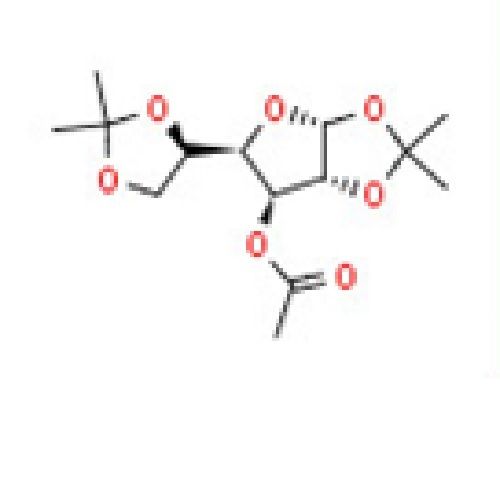
Chemical Name: 3-O-Acetyl-1,2:5,6-di-o-isopropylidene-alpha-d-glucofuranose
Synonyms :3-O-ACETYL-1,2:5,6-DI-O-ISOPROPYLIDENE-ALPHA-D-GLUCOFURANOSE
| 3-O-Acetyl-1,2:5,6-di-O-isopropylidene-a-D-glucofuranose
(3aR,5R,6S,6aR)-5-[(4R)-2,2-dimethyl-1,3-dioxolan-4-yl]-2,2-dimethyl-3a,5,6,6a-tetrahydrofuro[2,3-d1,3]dioxol-6-yl]acetate
|(3AR,5R,6S,6aR)-5-((R)-2,2-dimethyl-1,3-dioxolan-4-yl)-2,2-dimethyltetrahydrofuro[2,3-d1,3]dioxol-6-ylacetate
Cas No : 16713-80-7
Purity : 95%
MolecularFormula : C14H22O7
Molecular Weight:302.3
Appearance:SolidAdvanced Protective Group for Carbohydrate Chemistry3-O-Acetyl-1,2:5,6-di-O-isopropylidene-alpha-D-glucofuranose is widely recognized for its efficacy as a protective group in carbohydrate and organic synthesis. This facilitates selective functionalization during multi-step synthetic processes, enabling chemists to protect specific hydroxyl groups efficiently and reliably.
High Purity and Reliable PerformanceWith a purity greater than 99% and a consistent crystalline form, this compound assures high performance in laboratory and industrial applications. Its neutral pH and non-toxic nature make it particularly suitable for sensitive synthetic procedures where product quality and safety are paramount.
Versatile Applications and Easy StorageBeyond its central role in protecting carbohydrate molecules, this reagent functions as an intermediate for a variety of sugar synthesis routes. Its chemical stability, long shelf life, and straightforward ambient storage requirements contribute to its popularity among research and industry professionals.
FAQs of 3-O-Acetyl-1,2:5,6-di-o-isopropylidene-alpha-d- glucofuranose:
Q: How should 3-O-Acetyl-1,2:5,6-di-O-isopropylidene-alpha-D-glucofuranose be stored for optimal shelf life?
A: For optimal stability and activity, this compound should be stored in a cool, dry place in a well-sealed container. Under these conditions, it maintains its quality for up to 24 months.
Q: What are the primary applications of this carbohydrate derivative in organic synthesis?
A: It is primarily used as a protective group for hydroxyl moieties in carbohydrate chemistry, aiding in the preparation of acetyl derivatives and facilitating multi-step synthesis of sugars.
Q: When is this compound favored over other protective groups in carbohydrate chemistry?
A: This compound is chosen when selective protection of multiple hydroxyl groups is desired, especially in processes where stability in organic solvents like chloroform and ethyl acetate is necessary.
Q: Where can 3-O-Acetyl-1,2:5,6-di-O-isopropylidene-alpha-D-glucofuranose be sourced?
A: It is available from laboratory chemical suppliers and traders in India and internationally, marketed under synonyms such as Diacetone-alpha-D-glucofuranose acetate.
Q: What process is recommended for dissolving this reagent for use in synthesis?
A: Dissolution is best achieved using organic solvents like chloroform or ethyl acetate. It is only partially soluble in water, so these solvents are preferred for preparatory work.
Q: What are the notable benefits of using this product in laboratory synthesis?
A: Key benefits include high purity, reliable performance, non-toxicity, and ease of handling. The compound also offers excellent protection and is easy to remove during deprotection steps.






![(3aR,6aR)-tert-butyl hexahydropyrrolo[3,4-b]pyrrole-5(1H)-carboxylate](https://cpimg.tistatic.com/10008569/b/4/-3aR-6aR-tert-butyl-hexahydropyrrolo-3-4-b-pyrrole-5-1H-carboxylate.jpg?tr=w300)
 Send Inquiry
 Send Inquiry
 Send SMS
 Call Me Free


