Product Description
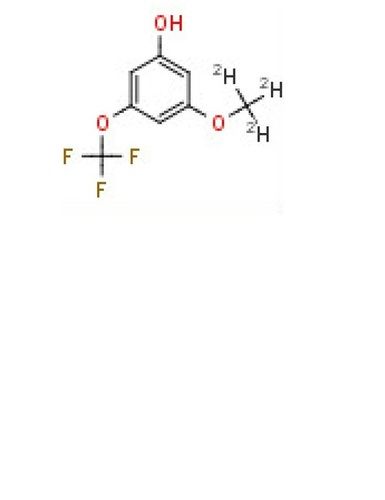
Chemical Name: 3-(Methoxy-D3)5-(trifluoromethoxy)phenol|
Synonyms : 3-(Trideuteriomethoxy)-5-(trifluoromethoxy)phenol|
3-(METHOXY-D3)-5-(TRIFLUOROMETHOXY)PHENOL
Cas No : 2222511-99-9
Purity : 95%
MolecularFormula : C8H7F3O3
Molecular Weight: 211.2
Exceptional Isotope Labeling for ResearchWith the methoxy group fully deuterated (>98% D atom), this compound is ideal for applications that require precise isotopic tracking. Its high chemical purity and stability support robust research demands in pharmaceutical and medicinal chemistry fields.
Safe Handling and Flexible Packaging OptionsClassified as non-dangerous and non-hazardous, this compound allows for ease of storage and transport. Customizable packing sizes (typically 10 mg, 50 mg, 100 mg) offer convenient solutions for varied research needs while maintaining shelf life when stored at 2-8C in a dry, dark environment.
FAQs of 3-(Methoxy-D3)5-(trifluoromethoxy) phenol:
Q: How should 3-(Methoxy-D3)5-(trifluoromethoxy) phenol be stored for optimal stability?
A: Store the compound at 2-8C, in tightly closed containers, within a dry and dark environment. Following these conditions ensures the product maintains its stability and a shelf life of at least 24 months.
Q: What are the primary uses and benefits of this deuterated compound?
A: 3-(Methoxy-D3)5-(trifluoromethoxy) phenol is primarily employed in pharmaceutical research, deuterium labeling studies, and medicinal chemistry. Its deuteration enhances tracing abilities in analytical methods, supporting advanced R&D and synthesis applications.
Q: When should this compound be chosen over its non-deuterated analogs?
A: Select this deuterated derivative when experiments require tracking via deuterium incorporation, enhanced stability, or reduced metabolic breakdown, especially in studies involving isotopic effects in pharmaceutical or chemical synthesis research.
Q: Where is this compound typically applied within laboratory processes?
A: It is commonly used in analytical studies, synthesis of labeled pharmaceuticals, investigation of metabolic pathways, and as a reference standard in advanced research labs specializing in medicine and chemistry.
Q: What is the recommended process for handling and dissolving this compound?
A: Handle with appropriate laboratory safety measures, even though it is non-poisonous. The compound dissolves readily in organic solvents like DMSO and acetonitrile, ensuring efficient preparation for experimental protocols.
Q: Is there any regulatory restriction or hazard classification for transportation?
A: No, this compound is non-dangerous and not classified as hazardous for transport. It is not regulated under UN numbers and is safe to ship following standard chemical transport guidelines.







 Send Inquiry
 Send Inquiry
 Send SMS


