Product Description
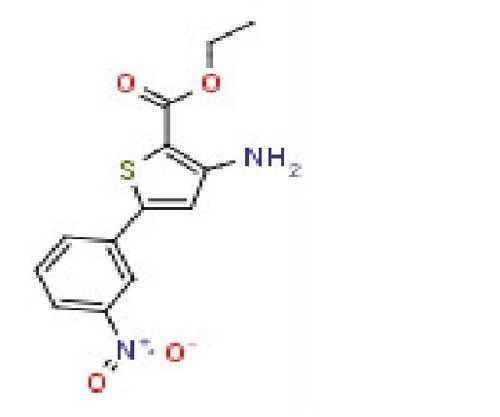
Chemical Name: 3-Amino-5-(3-nitro-phenyl)-thiophene-2-carboxylicacid ethyl ester
Synonyms : ethyl3-amino-5-(3-nitrophenyl)thiophene-2-carboxylate
| 3-Amino-5-(3-nitro-phenyl)-thiophene-2-carboxylicacid ethyl ester
| Ethyl3-amino-5-(3-nitrophenyl)-thiophene-2-carboxylate
Cas No : 730949-83-4
Purity : 95%
MolecularFormula : C13H12N2O4S
Molecular Weight : 292.3Applications in Organic ResearchThis compound serves as a vital intermediate in pharmaceutical development and heterocyclic compound synthesis. Its unique molecular structure lends itself well to organic research settings, acting as a building block for more complex molecules. Researchers benefit from its high purity and stability under standard laboratory conditions.
Handling and Safety PrecautionsDue to its harmful effects if swallowed and potential for skin and eye irritation, appropriate safety measures such as wearing protective clothing and gloves, and handling inside a chemical fume hood, are necessary. The compound should only be utilized by trained personnel in research laboratories, ensuring minimal risk during use.
Storage and Packaging RecommendationsTo maintain product quality and stability, store the compound at temperatures between 2-8C in a cool, dry, and ventilated area, protected from light. Sealed amber bottles or aluminum foil bags are recommended for packaging to reduce light exposure and moisture ingress, preserving its efficacy throughout its shelf life.
FAQ's of 3-Amino-5-(3-nitro-phenyl)-thiophene-2-carboxylic acid ethyl ester:
Q: How should 3-Amino-5-(3-nitro-phenyl)-thiophene-2-carboxylic acid ethyl ester be stored for optimal stability?
A: The compound should be stored at 2-8C in a cool, dry, and well-ventilated area, inside sealed containers such as amber bottles or aluminum foil bags to protect it from light and moisture.
Q: What is the recommended process for handling this pharmaceutical intermediate?
A: Handling must be conducted with protective gloves and clothing, within a chemical fume hood to avoid exposure. Access should be limited to trained laboratory personnel, following standard safety protocols.
Q: When does the compound decompose and does it have a conventional boiling point?
A: This compound decomposes before reaching its boiling point, so it does not have a traditional boiling temperature. Heating should be avoided to prevent degradation.
Q: Where can this compound be used and what are its primary applications?
A: It is mainly used in research laboratories as a pharmaceutical intermediate and for heterocyclic compound synthesis in the development of complex organic molecules.
Q: What benefits does using this intermediate provide in organic synthesis?
A: The compound's high purity and unique structure are advantageous for synthesizing heterocyclic compounds and pharmaceutical molecules, offering reliability for reproducible research outcomes.
Q: How should the compound be disposed of after laboratory use?
A: Disposal must follow local chemical waste management regulations. It should not be poured down the drain and must be collected by authorized hazardous waste handlers to ensure environmental safety.
Q: What precautions should be taken to ensure safe usage of this compound?
A: Suitable protective clothing and gloves should always be worn, and procedures must only be performed in a chemical fume hood. Avoid direct contact and ingestion due to its harmful nature.






![1-[4-(Acetylamino)phenyl]-5-oxopyrrolidine-3-carboxylic acid](https://cpimg.tistatic.com/09660839/b/4/1-4-Acetylamino-phenyl-5-oxopyrrolidine-3-carboxylic-acid.jpg?tr=w300)
 Send Inquiry
 Send Inquiry
 Send SMS
 Call Me Free


