Product Description
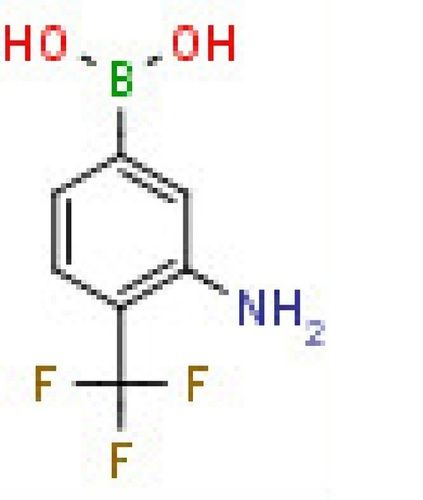
Chemical Name: 3-Amino-4-(trifluoromethyl)phenylboronicacid
Synonyms : [3-amino-4-(trifluoromethyl)phenyl]boronicacid |
(3-Amino-4-(trifluoromethyl)phenyl)boronicacid
CAS No : 2377607-83-3
Purity : 95%
MolecularFormula : C7H7BF3NO2
Molecular Weight: 204.9
Appearance: SolidVersatile Chemical Intermediate for Research and Synthesis3-Amino-4-(trifluoromethyl)phenylboronic acid plays a critical role as a building block in pharmaceutical and organic synthesis. Its distinct functional groups allow participation in Suzuki-Miyaura coupling and other advanced research applications. The compounds stability and high purity make it ideal for laboratory use where reliable and reproducible results are essential.
Safe Handling and PackagingThis compound is classified as non-hazardous under GHS; however, users are advised to wear gloves, goggles, and lab coats. It is supplied in 1g, 5g, and custom bulk quantities, with each package designed to protect against moisture. For longevity, containers should remain tightly closed and stored in cool, dry environments.
Physical and Chemical PropertiesThis solid, crystalline substance melts between 185-189C and boasts a molecular weight of 204.95 g/mol. Its relatively soluble in DMSO but only slightly in water. The stable framework of this boronic acid supports its use in research where controlled reactivity is advantageous.
FAQs of 3-Amino-4-(trifluoromethyl)phenylboronic acid:
Q: How should 3-Amino-4-(trifluoromethyl)phenylboronic acid be properly stored?
A: To preserve its quality, keep the compound in a tightly closed container, stored in a cool, dry place and away from moisture, as it is moisture sensitive.
Q: What is the main benefit of using this compound in research?
A: Its unique structure, combining an amino and a trifluoromethyl group, enables efficient participation in Suzuki-Miyaura coupling and other organic synthesis reactions, making it valuable for developing pharmaceuticals and advanced materials.
Q: When is the ideal time to use this substance in synthetic processes?
A: It is best utilized during the intermediate or coupling stages of pharmaceutical or fine chemical synthesis, particularly where a stable and reactive boronic acid is required for forming carboncarbon bonds.
Q: Where is this product commonly applied in industry or research?
A: The compound is widely used in pharmaceutical research, organic synthesis, and academic laboratories for R&D, especially in the development of new chemical entities and synthetic methods.
Q: What safety precautions should be observed while handling the product?
A: While it is classified as non-hazardous, always use appropriate personal protective equipment such as gloves, goggles, and lab coats, and avoid inhaling dust or direct skin contact.
Q: How is the product packaged and transported?
A: It is typically supplied in 1g, 5g, or custom bulk packaging and is not regulated as dangerous goods for transport, making shipping straightforward.
Q: What is the process for utilizing this compound in Suzuki coupling reactions?
A: In Suzuki coupling, this boronic acid is combined with suitable halides and a palladium catalyst under specified conditions to form biaryl or substituted aromatic products, vital in pharmaceutical and materials science research.







![[4-Amino-2-(trifluoromethyl)phenyl] (4-methyl-1-piperazinyl)methanone](https://cpimg.tistatic.com/10039099/b/4/-4-Amino-2-trifluoromethyl-phenyl-4-methyl-1-piperazinyl-methanone.jpg?tr=w300)
![Benzyl [2-(3,5-bis(trifluoromethyl)phenyl)-1-methyl-2-oxo-ethyl]carbamate](https://cpimg.tistatic.com/10074265/b/4/Benzyl-2-3-5-bis-trifluoromethyl-phenyl-1-methyl-2-oxo-ethyl-carbamate.jpg?tr=w300)
 Send Inquiry
 Send Inquiry
 Send SMS
 Call Me Free


