Product Description
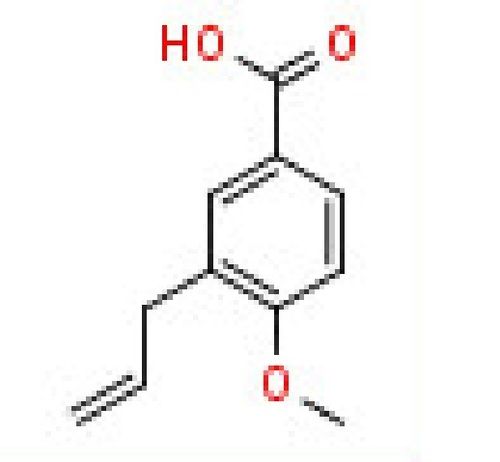
Chemical Name: 3-Allyl-4-methoxybenzoicacid
Synonyms : 3-Allyl-4-methoxy-benzoicacid
| 4-methoxy-3-prop-2-enylbenzoicacid
| 4-methoxy-3-(prop-2-en-1-yl)benzoicacid
Cas No : 7501-09-9
Purity : 95%
MolecularFormula : C11H12O3
Molecular Weight : 192.2Properties and Stability3-Allyl-4-methoxybenzoic acid is noted for its stable nature under recommended storage conditions and for being non-hazardous. Its light yellow crystalline appearance and acidic character make it suitable for diverse chemical processes. The compound remains solid at room temperature and should be stored tightly sealed, in a cool, dry place away from light to maximize shelf life.
Applications in Synthesis and ResearchUsed primarily as a pharmaceutical intermediate, this compound is vital in the creation of various organic and medicinal products. Researchers utilize it in chemical development projects due to its purity greater than 98%. Its solubility profile allows for versatile application in different organic solvent systems, facilitating straightforward integration into laboratory protocols.
FAQ's of 3-Allyl-4-methoxybenzoic acid:
Q: How should 3-Allyl-4-methoxybenzoic acid be stored to ensure maximum stability?
A: Store the compound in a tightly sealed container, kept in a cool, dry location and protected from direct light. These conditions help maintain stability and extend shelf life up to 24 months.
Q: What are the typical uses of 3-Allyl-4-methoxybenzoic acid?
A: This product is mainly used as a pharmaceutical intermediate and for chemical research, particularly in the synthesis of pharmaceuticals and various organic compounds.
Q: When is it recommended to handle the product during synthesis processes?
A: Handle 3-Allyl-4-methoxybenzoic acid during the initial or intermediate phases of organic synthesis, as its chemical properties are beneficial for constructing complex molecules within research and industrial settings.
Q: Where can this compound be applied in laboratory settings?
A: It is suitable for use in laboratories involved in pharmaceutical development, organic chemistry research, and the development of novel compounds, especially where high purity and acidic nature are required.
Q: What benefit does its high purity offer in chemical research?
A: The purity level above 98% ensures minimal interference from contaminants, improving the reliability of experimental results and the quality of synthesized materials.
Q: Is there any special process required for its handling or transport?
A: No special processes are required. The compound is not regulated as dangerous goods and not classified in any packing group, making handling and transport straightforward under ordinary conditions.






![7-Azabicyclo[2.2.1]heptane-2-carboxylic acid ethyl ester hydrochloride](https://cpimg.tistatic.com/10032258/b/4/7-Azabicyclo-2-2-1-heptane-2-carboxylic-acid-ethyl-ester-hydrochloride.jpg?tr=w300)
 Send Inquiry
 Send Inquiry
 Send SMS
 Call Me Free


