Product Description
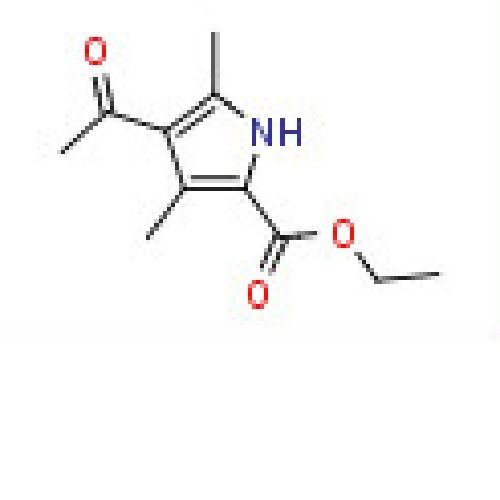
Chemical Name: 3-Acetyl-2,4-dimethyl-5-carbethoxypyrrole
Synonyms :ethyl 4-acetyl-3,5-dimethyl-1H-pyrrole-2-carboxylate
| 3-Acetyl-2,4-dimethyl-5-carbethoxypyrrole
| 1H-Pyrrole-2-carboxylic acid, 4-acetyl-3,5-dimethyl-,ethyl ester
| 2,4-DIMETHYL-3-ACETYL-5-CARBETHOXYPYRROLE
Cas No : 2386-26-7
Purity : 98%
MolecularFormula : C11H15NO3
Molecular Weight:209.2
Appearance:SolidUnique Structure and Physical Characteristics3-Acetyl-2,4-dimethyl-5-carbethoxypyrrole possesses a characteristic aromatic, slightly aromatic smell and appears either as a white to off-white crystalline solid or powder. Its significant solubility in organic solvents makes it highly adaptable to diverse laboratory applications. The compound maintains stability under standard recommended storage conditions, with a density of 1.13 g/cm3 and a melting point between 80-84C.
Safe Handling and Storage GuidelinesThough not classified as hazardous under GHS, proper precautions should always be taken when handling this chemical. It is essential to wear personal protective equipment and avoid contact with skin, eyes, and inhalation of dust. Store the compound in a cool, dry, well-ventilated place in tightly closed containers to preserve its effectiveness for up to two years.
Applications in Research and Industry3-Acetyl-2,4-dimethyl-5-carbethoxypyrrole is highly valued as an intermediate in the synthesis of pharmaceuticals and fine chemicals. Its stability and reliable solubility profile make it particularly useful in laboratory research and the development of new chemical products. The compound's purity and grade suit both industrial and R&D requirements.
FAQ's of 3-Acetyl-2,4-dimethyl-5- carbethoxypyrrole:
Q: How should 3-Acetyl-2,4-dimethyl-5-carbethoxypyrrole be handled and stored for optimal safety and stability?
A: This compound should be handled with personal protective equipment to avoid inhalation and contact with skin or eyes. Always store it in a tightly closed container, in a cool, dry, and well-ventilated environment to maintain its stability and extend its shelf life to up to two years.
Q: What are the primary uses and benefits of 3-Acetyl-2,4-dimethyl-5-carbethoxypyrrole in industry and research?
A: This chemical serves as a key intermediate in the synthesis of pharmaceuticals and fine chemicals. Its high purity and stability offer reliable performance in research and development settings, contributing to efficient and reproducible synthesis processes.
Q: When is it necessary to use protective equipment while working with this compound?
A: Personal protective equipment should be used at all times during handling to minimize the risk of exposure through inhalation, skin, or eye contact, even though it is not classified as hazardous.
Q: What is the process for disposing of 3-Acetyl-2,4-dimethyl-5-carbethoxypyrrole safely?
A: Disposal should follow local chemical waste regulations and institutional guidelines since it is a laboratory and industrial-grade intermediate. It is not classified as hazardous, but careful disposal is essential to maintain safety standards.
Q: Where can 3-Acetyl-2,4-dimethyl-5-carbethoxypyrrole typically be purchased and shipped?
A: The compound can be sourced from chemical suppliers and traders, especially those operating out of India. Ensure your supplier provides the necessary documentation, such as MSDS, for safe and compliant handling.
Q: What are the physical properties that make this compound suitable for laboratory and industrial use?
A: Its white to off-white solid form, moderate melting point, stable density, solubility in organic solvents, and stability under recommended storage make it easy to handle and incorporate into various synthesis processes.






![(1Alpha,8alpha,9alpha)-bicyclo[6.1.0]non-4-ene-9-carboxylic acid ethyl ester](https://cpimg.tistatic.com/09707352/b/4/-1Alpha-8alpha-9alpha-bicyclo-6-1-0-non-4-ene-9-carboxylic-acid-ethyl-ester.jpg?tr=w300)
![(3Ar*,6ar*)-benzylhexahydropyrrolo [3,2-b]pyrrole-1(2h)-carboxylate](https://cpimg.tistatic.com/10008368/b/4/-3Ar-6ar-benzylhexahydropyrrolo-3-2-b-pyrrole-1-2h-carboxylate.jpg?tr=w300)
 Send Inquiry
 Send Inquiry
 Send SMS


