Product Description
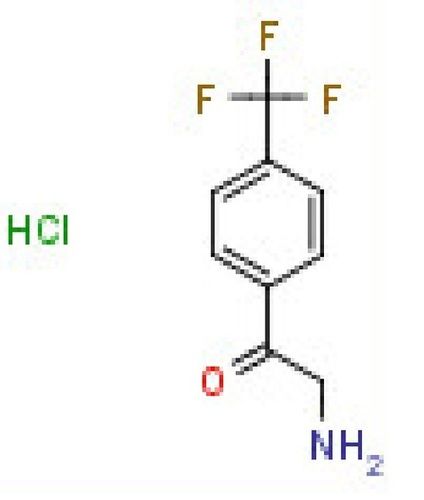
Chemical Name: 2-Amino-1-(4-(trifluoromethyl)phenyl)ethanonehydrochloride
Synonyms : 2-amino-1-[4-(trifluoromethyl)phenyl]ethanone;hydrochloride|
2-Amino-1-(4-(trifluoromethyl)phenyl)ethanonehydrochloride|
2-AMINO-4-TRIFLUOROMETHYLACETOPHENONEHYDROCHLORIDE |
2-Amino-1-(4-(trifluoromethyl)phenyl)ethanoneHCl |
2-Amino-1-[4-(trifluoromethyl)phenyl]ethanonehydrochloride |
2-AMINO-1-(4-(TRIFLUOROMETHYL)PHENYL)ETHANONE|
Ethanone,2-amino-1-[4-(trifluoromethyl)phenyl]-, hydrochloride
CAS No : 339-58-2
Purity : 95%
MolecularFormula : C9H8F3NO.ClH
Molecular Weight: 239.6
Appearance: Solid
Reliable Grade for Research and SynthesisThis compound is specially manufactured for laboratory and research purposes, ensuring consistent high purity and stability for reproducible results. Each batch is supported by a Certificate of Analysis, available upon request, detailing assay (via HPLC), impurity profile, and heavy metals content. Its crystalline, odorless form is easily handled and measured for precise pharmaceutical and chemical syntheses.
Stable and Safe PackagingPacked in sealed HDPE bottles or aluminium packaging, 2-Amino-1-(4-(trifluoromethyl)phenyl)ethanone hydrochloride remains protected from moisture, ensuring optimal shelf life and product integrity. The product is classified as non-hazardous for transport, facilitating smooth and compliant shipping. Proper storage in a cool, dry place, tightly sealed, retains stability for up to 24 months.
FAQs of 2-Amino-1-(4-(trifluoromethyl)phenyl)ethanone hydrochloride:
Q: How should 2-Amino-1-(4-(trifluoromethyl)phenyl)ethanone hydrochloride be stored to maintain its stability?
A: To ensure long-term stability and maintain high purity, store the compound tightly sealed in a cool, dry environment, away from moisture. The substance is moisture sensitive, so proper packaging and storage are critical.
Q: What are the main applications of this product in research and industry?
A: 2-Amino-1-(4-(trifluoromethyl)phenyl)ethanone hydrochloride serves as a versatile building block in pharmaceutical synthesis and chemical research, where it is used to create medicinal compounds and advanced chemical intermediates.
Q: When is it necessary to use protective equipment while handling this material?
A: Gloves and protective equipment should always be used when handling this compound to avoid skin contact, accidental ingestion, or inhalation, despite its low toxicity rating.
Q: Where is this chemical typically sourced and supplied from?
A: This product is supplied by certified suppliers and traders, mainly in India, and distributed in research-grade quality suitable for laboratory use worldwide.
Q: What is the benefit of its non-hazardous transport classification?
A: Being non-hazardous for transport means the product is not regulated as dangerous goods, making shipping simpler and less costly, while also reducing regulatory compliance requirements.
Q: How is the assay of 2-Amino-1-(4-(trifluoromethyl)phenyl)ethanone hydrochloride determined?
A: The purity and assay of this compound are measured using High Performance Liquid Chromatography (HPLC), ensuring accurate and reproducible quality control for every batch.
Q: What is the process to obtain a Certificate of Analysis for this product?
A: A Certificate of Analysis (COA) for the batch can be provided by the supplier upon request, documenting assay, impurity profile, heavy metals, and compliance with specified standards.






![Benzeneacetamide, 4-fluoro-n-[4-(5-oxazolyl)phenyl]-](https://cpimg.tistatic.com/10064493/b/4/Benzeneacetamide-4-fluoro-n-4-5-oxazolyl-phenyl-.jpg?tr=w300)
![6-Benzyl-2,4-dichloro-8,8-difluoro-5,6,7,8-tetrahydropyrido[4,3-d]pyrimidine hydrochloride](https://cpimg.tistatic.com/10077433/b/4/6-Benzyl-2-4-dichloro-8-8-difluoro-5-6-7-8-tetrahydropyrido-4-3-d-pyrimidine-hydrochloride.jpg?tr=w300)
 Send Inquiry
 Send Inquiry
 Send SMS
 Call Me Free


