Product Description
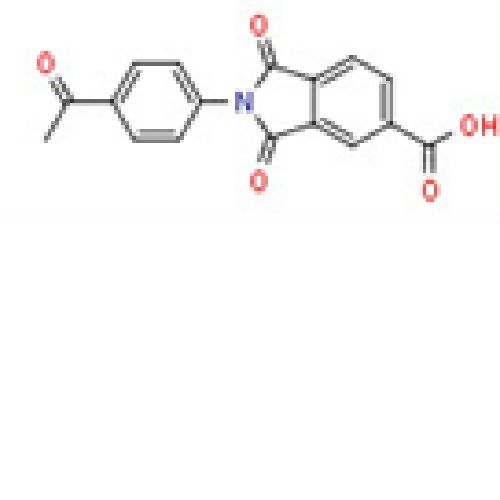
Chemical Name: 2-(4-Acetylphenyl)-1,3-dioxoisoindoline-5-carboxylicacid
Synonyms :2-(4-acetylphenyl)-1,3-dioxoisoindole-5-carboxylic acid
|2-(4-acetylphenyl)-1,3-dioxo-2,3-dihydro-1H-isoindole-5-carboxylic acid
Cas No : 300405-47-4
Purity : 95%
Molecular Formula: C17H11NO5
Molecular Weight:309.3
Appearance:SolidApplications in Research and IndustryThis compound is primarily used as a pharmaceutical intermediate and in organic synthesis processes, making it a valuable asset for medicinal chemistry research. Its high purity and stability support reliable experimental outcomes, allowing researchers to confidently incorporate it into various analytical and synthetic protocols. Strictly intended for laboratory use, it is not suitable for consumer or therapeutic applications.
Safe Handling and Storage Guidelines2-(4-Acetylphenyl)-1,3-dioxoisoindoline-5-carboxylic acid should be handled with standard laboratory safety precautions as described in its Safety Data Sheet. Store the compound in a tightly capped container within a cool, dry, and well-ventilated area. These measures help ensure product stability and a shelf life of up to 24 months. Consult the MSDS for detailed hazard and first-aid information.
FAQ's of 2-(4-Acetylphenyl)-1,3-dioxoisoindoline-5-carboxylic acid:
Q: How should 2-(4-Acetylphenyl)-1,3-dioxoisoindoline-5-carboxylic acid be stored for maximum stability?
A: Store the substance in a cool, dry, and well-ventilated area, tightly capped in its original sealed HDPE bottle or glass vial. This ensures stability and preserves shelf life for up to 24 months.
Q: What is the primary usage of this compound in a laboratory setting?
A: It is used as a pharmaceutical intermediate and for organic synthesis in medicinal chemistry research. It is strictly for laboratory research and must not be used for drug, household, or food applications.
Q: When is it necessary to refer to the MSDS before handling this compound?
A: Always consult the Material Safety Data Sheet (MSDS) prior to use to understand hazard information and recommended handling precautions, even though it is classified as non-poisonous.
Q: Where can this compound be applied within the research industry?
A: It is suitable for pharmaceutical development, organic synthesis, and other chemical research areas in academic, industrial, or pharmaceutical laboratory environments.
Q: What benefits does this compound offer to researchers?
A: Researchers benefit from its high purity (>98%), stability under recommended conditions, and reliable performance in synthesis and analysis, supporting consistent experimental results.
Q: How is the product packaged and why is that important?
A: It is packaged in sealed HDPE bottles or glass vials, which protects the compound from moisture and contamination, maintaining its quality until use.






![4-Amino-bicyclo[2.2.2]octane-1-carboxylic acid methylamide, hydrochloride](https://cpimg.tistatic.com/09731376/b/4/4-Amino-bicyclo-2-2-2-octane-1-carboxylic-acid-methylamide-hydrochloride.jpg?tr=w300)
 Send Inquiry
 Send Inquiry
 Send SMS


