Product Description
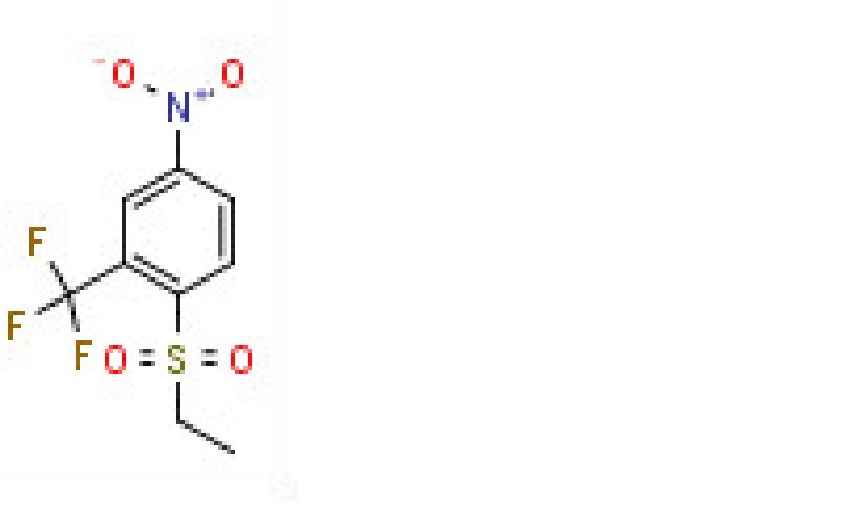
Chemical Name: 1-(Ethanesulfonyl)-4-nitro-2-(trifluoromethyl)benzene
CAS No : 1820615-46-0
Purity : 95%
MolecularFormula : C9H8F3NO4S
Molecular Weight:283.2
Appearance : SolidChemical Properties and StructureThis yellow crystalline solid (C9H8F3NO4S) displays significant electron-withdrawing characteristics due to its nitro and trifluoromethyl groups. With a melting point of 90-95C and density of 1.48 g/cm3, the compound retains stability under recommended storage, making it suitable for laboratory and research environments.
Applications in Synthesis1-(Ethanesulfonyl)-4-nitro-2-(trifluoromethyl)benzene is primarily utilized as an intermediate for synthesizing pharmaceuticals and agrochemicals. Its unique functional groups enhance its value in organic synthesis and development of specialized materials, contributing to innovative research in multiple scientific fields.
Safe Handling and StorageAlthough classified as non-poisonous and non-regulated for transport, it is essential to wear appropriate protective clothing and eye protection when handling this compound. Store the material in sealed HDPE bottles or glass vials in a cool, dry, well-ventilated area away from direct light and incompatible substances to maintain stability and prolong shelf life.
FAQ's of 1-(Ethanesulfonyl)-4-nitro-2 -(trifluoromethyl)benzene:
Q: How should 1-(Ethanesulfonyl)-4-nitro-2-(trifluoromethyl)benzene be safely handled in the laboratory?
A: Always wear suitable protective clothing, gloves, and eye protection when handling this compound. Although not classified as highly toxic, it should be treated as potentially hazardous, and measures should be taken to prevent inhalation or direct skin contact.
Q: What is the primary use of this chemical in industry and research?
A: It serves mainly as an intermediate for pharmaceutical and agrochemical synthesis, as well as a reagent in organic synthesis and the development of advanced functional materials.
Q: When and how should this compound be stored for optimal stability?
A: Store the compound in a sealed HDPE bottle or glass vial in a cool, dry, well-ventilated location, protected from light and incompatible chemicals. Following these guidelines can ensure stability for up to 2 years.
Q: Where can this compound be transported, and are there any special shipping requirements?
A: This substance is classified as non-hazardous for transport and does not require special shipping protocols. It can be safely shipped via standard methods, provided containers are properly sealed.
Q: What benefits does the presence of nitro and trifluoromethyl groups offer?
A: The nitro and trifluoromethyl groups provide strong electron-withdrawing capability, making this compound especially valuable as a building block for synthesizing advanced pharmaceuticals and agrochemicals requiring these chemical features.
Q: What solvents is this compound soluble in, and what should be avoided?
A: 1-(Ethanesulfonyl)-4-nitro-2-(trifluoromethyl)benzene is slightly soluble in organic solvents such as DMSO and DMF, but it is insoluble in water. Choose appropriate organic solvents for dissolution in research applications.






![[(1,1-Dioxidotetrahydro-3- thienyl)methyl]amine](https://cpimg.tistatic.com/11570691/b/4/-1-1-Dioxidotetrahydro-3-thienyl-methyl-amine.jpg?tr=w300)
 Send Inquiry
 Send Inquiry
 Send SMS
 Call Me Free


