Product Description
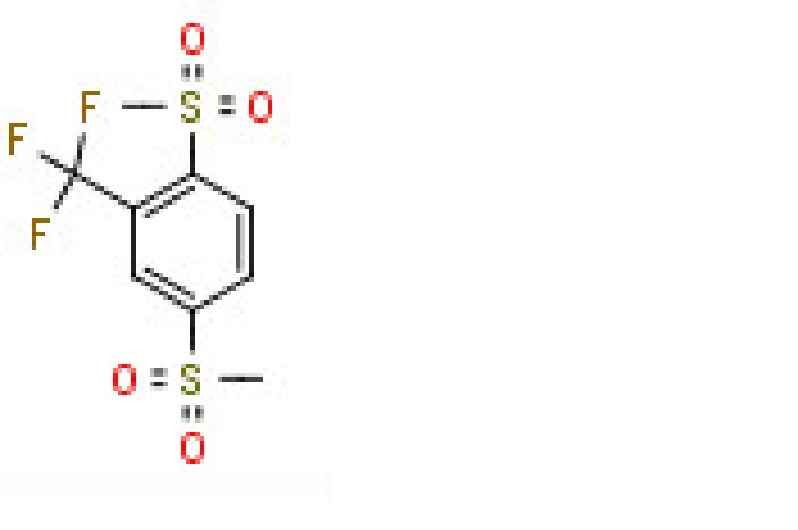
Chemical Name: 1,4-Dimethanesulfonyl-2-(trifluoromethyl)benzene
Synonyms : 1,4-bis(methylsulfonyl)-2-(trifluoromethyl)benzene
CAS No : 1445322-52-0
Purity : 98%
MolecularFormula :C9H9F3O4S2
Molecular Weight:302.3
Appearance : SolidHigh Purity and StabilityThis compound boasts exceptional chemical purity (>98%) and is stable under standard laboratory conditions. It does not degrade or decompose easily and is non-hygroscopic, ensuring reliable performance during research and synthesis. With a two-year shelf life when stored correctly, it provides consistent quality for scientific applications.
Safe Handling and Easy Storage1,4-Dimethanesulfonyl-2-(trifluoromethyl)benzene is not classified as hazardous according to GHS. It should be handled with standard personal protective equipment and good ventilation. The solid is conveniently packed in airtight containers to maintain integrity, and should be stored in a cool, dry, and well-ventilated location to preserve stability.
Versatile Applications in SynthesisWidely used as a building block in pharmaceutical research and fine chemical synthesis, this compound offers significant versatility for R&D applications. Its compatibility as an intermediate in complex synthetic pathways makes it an essential resource for laboratories, pharmaceutical companies, and chemical manufacturers.
FAQ's of 1,4-Dimethanesulfonyl- 2-(trifluoromethyl)benzene:
Q: How should 1,4-Dimethanesulfonyl-2-(trifluoromethyl)benzene be stored to ensure maximum stability?
A: Store the compound in tightly closed containers at a cool, dry, and well-ventilated place. Under recommended conditions, it remains stable and non-hygroscopic, with a shelf life of 24 months.
Q: What are the primary uses and benefits of this compound in the laboratory?
A: This compound is primarily used as a building block for pharmaceutical and chemical synthesis, enabling researchers to develop new molecules and intermediates. Its high purity and stability make it highly beneficial for research and development tasks.
Q: When is it necessary to use personal protective equipment while handling this chemical?
A: Personal protective equipment (gloves, goggles, lab coats) should always be used when handling this compound, especially during weighing, mixing, or transferring, to ensure safe laboratory practices despite its non-hazardous classification.
Q: Where can this chemical be sourced in India, and what packaging sizes are available?
A: It is available through reputable suppliers and traders in India and can be purchased in 1g, 5g, and 25g sealed containers, convenient for both small-scale and larger research requirements.
Q: What precautions should be taken during the handling process?
A: While the chemical is not hazardous under GHS, it should be used with adequate ventilation and personal protective equipment. Avoid contact with strong oxidizing agents to prevent unwanted reactions.
Q: How does the physical form and solubility affect its application in chemical synthesis?
A: As a crystalline solid that is slightly soluble in organic solvents like DMSO and DMF, it is easily manipulated in laboratory settings and integrates efficiently into a variety of organic reactions in research and industrial applications.
Q: What is the benefit of using this chemical as an intermediate in pharmaceutical synthesis?
A: Its high chemical purity, stability, and compatibility make it an ideal intermediate for creating complex pharmaceutical compounds, contributing to efficient and reproducible synthesis in R&D projects.







 Send Inquiry
 Send Inquiry
 Send SMS
 Call Me Free


