Product Description
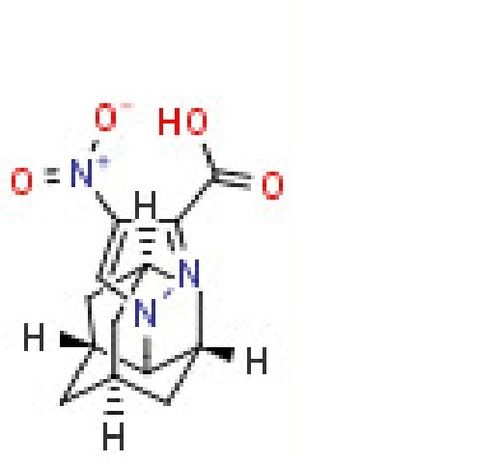
Chemical Name: 1-(2-Adamantyl)-4-nitro-1h-pyrazole-3-carboxylicacid
Synonyms :1-(2-adamantyl)-4-nitro-1H-pyrazole-3-carboxylic acid
| 1-(Adamantan-2-yl)-4-nitro-1H-pyrazole-3-carboxylic acid
| 1-(2-adamantyl)-4-nitropyrazole-3-carboxylic acid
|4-nitro-1-(tricyclo[3.3.1.13,7]dec-2-yl)-1H-pyrazole-3-carboxylic acid
Cas No : 1306739-32-1
Purity : 95%
MolecularFormula : C14H17N3O4
Molecular Weight :291.3Reliable Analytical Grade for Innovative ResearchThis compound provides an excellent choice for pharmaceutical and chemical research. Its analytical-grade purity ensures consistent results, supporting advanced applications in organic synthesis of pyrazole derivatives. Its robust stability and high reactivity make it a preferred intermediate in laboratory settings.
Safe Handling and Flexible PackagingPackaged in secure HDPE bottles and available in various quantities, this product is straightforward to manage in laboratories. Though it is non-toxic and odorless, appropriate protective equipment should be used during handling. The compound is not regulated for transport, offering additional convenience.
Application Versatility and Long Shelf Life1-(2-Adamantyl)-4-nitro-1H-pyrazole-3-carboxylic acid's slight water solubility and compatibility with DMSO and DMF broaden its utility. Stored tightly in cool, dry conditions, it retains its chemical integrity for up to 24 months, ensuring reliable performance for research and synthesis projects.
FAQ's of 1-(2-Adamantyl)-4-nitro-1h-pyrazole-3-carboxylic acid:
Q: What are the recommended storage conditions for 1-(2-Adamantyl)-4-nitro-1H-pyrazole-3-carboxylic acid?
A: The compound should be stored in a cool, dry place in a tightly closed container to maintain its stability and prolong its shelf life, which is up to 24 months under recommended conditions.
Q: How should I handle and use this chemical safely in the laboratory?
A: Always wear suitable protective equipment, such as gloves, eye protection, and a lab coat during handling. While the substance is non-toxic and shows no hazardous properties under normal circumstances, standard laboratory protocols are advised.
Q: What is the primary application of this compound in research?
A: It is mainly used as an intermediate in the synthesis of pyrazole derivatives and serves as a valuable component in pharmaceutical research and other organic synthesis processes.
Q: When and where is the product typically used?
A: The compound is utilized in laboratories and research environments during studies and development projects that involve organic and pharmaceutical synthesis, particularly when pyrazole derivatives are required.
Q: What benefits does the nitro substituent provide in this chemical?
A: The nitro group enhances the compound's reactivity, making it more effective as an intermediate and providing greater versatility in synthetic research procedures.
Q: How is 1-(2-Adamantyl)-4-nitro-1H-pyrazole-3-carboxylic acid supplied and packaged?
A: It comes in HDPE bottles, available in 25g, 100g, and 1kg sizes, or other packaging as required for research and laboratory needs.
Q: Is transport regulated for this chemical, and what are its physical characteristics?
A: Transport of the compound is not regulated, facilitating shipment. It is a yellow to light brown crystalline solid, odorless, and slightly soluble in water with greater solubility in DMSO and DMF.






![1-[3-(Acetylamino)phenyl]-5-oxopyrrolidine-3-carboxylic acid](https://cpimg.tistatic.com/09660799/b/4/1-3-Acetylamino-phenyl-5-oxopyrrolidine-3-carboxylic-acid.jpg?tr=w300)
![2-Amino-4,7-dihydro-5h-thieno[2,3-c]pyridine-3,6-dicarboxylic acid 6-benzyl ester 3-methyl ester](https://cpimg.tistatic.com/09864592/b/4/2-Amino-4-7-dihydro-5h-thieno-2-3-c-pyridine-3-6-dicarboxylic-acid-6-benzyl-ester-3-methyl-ester.jpg?tr=w300)
 Send Inquiry
 Send Inquiry
 Send SMS
 Call Me Free


