Product Description
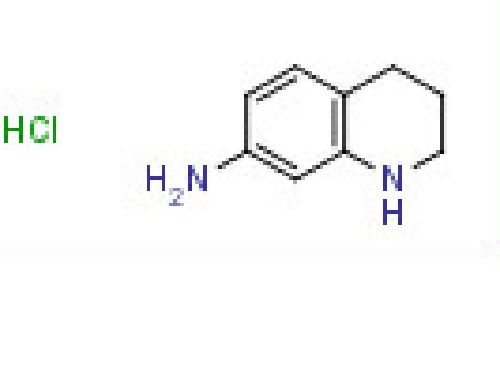
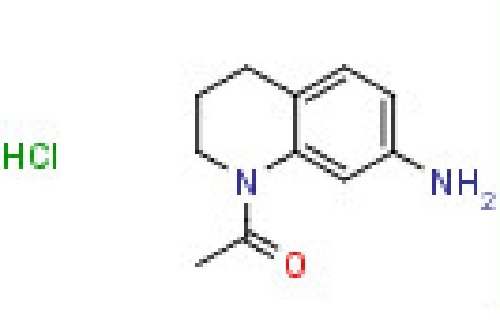
Chemical Name: 1,2,3,4-Tetrahydroquinolin-7-aminehydrochloride
Synonyms : 7-Quinolinamine,1,2,3,4-tetrahydro-, hydrochloride (1:2)
Cas No : 1309976-14-4
Purity : 95%
MolecularFormula : C9H12N2.ClH
Molecular Weight: 184.7
Appearance: SOLID Key Properties and Handling1,2,3,4-Tetrahydroquinolin-7-amine hydrochloride is recognized for its stability under recommended storage conditions and high purity (>98%). It is an odorless, crystalline powder that should be kept in tightly sealed containers, protected from light and moisture. Proper laboratory precautions must be observed to avoid unnecessary exposure.
Applications and UsageThis compound is designed specifically for use in laboratory research and development, including pharmaceutical synthesis and chemical research. It should not be used in drug, household, or food applications. Researchers benefit from its high purity and reliable solubility in a range of solvents, supporting precise experimental requirements.
Storage and TransportationStore the product in a cool, dry place and protect it from moisture and light for maximum stability. 1,2,3,4-Tetrahydroquinolin-7-amine hydrochloride is not classified as a hazardous or dangerous good for shipping, simplifying transportation logistics for scientific and industrial users.
FAQ's of 1,2,3,4-Tetrahydroquinolin-7-amine hydrochloride:
Q: How should 1,2,3,4-Tetrahydroquinolin-7-amine hydrochloride be handled and stored safely?
A: Handle this chemical using standard laboratory personal protective equipment, including gloves and safety glasses. It should be stored in a cool, dry location, tightly sealed, and protected from light and moisture. Refer to the MSDS for specialized handling guidelines.
Q: What are the main applications of 1,2,3,4-tetrahydroquinolin-7-amine hydrochloride?
A: This compound is mainly utilized in pharmaceutical synthesis and chemical research. It supports laboratory research and development, offering high-purity material for specialized chemical processes.
Q: When does this compound decompose or lose stability?
A: The substance remains stable when stored under recommended conditions. It decomposes upon melting at 205-210C, and is sensitive to moisture, so always keep it in a sealed, dry container.
Q: Where can this product be supplied from and in what packaging?
A: It is typically supplied in India by chemical suppliers and traders. Packaging is usually done in sealed HDPE bottles or glass vials to maintain product integrity during transport and storage.
Q: What is the process for dissolving this compound for use in experiments?
A: Dissolve the required amount in water or DMSO, as it is highly soluble in these solvents. Partial solubility is noted in methanol. Stirring may be required for complete dissolution depending on concentration and temperature.
Q: What benefits does this compound offer for laboratory research?
A: Researchers benefit from its high purity, reliable stability, and solubility, which are essential for reproducible results in specialized synthesis and chemical research.






 Send Inquiry
 Send Inquiry
 Send SMS


