Product Description
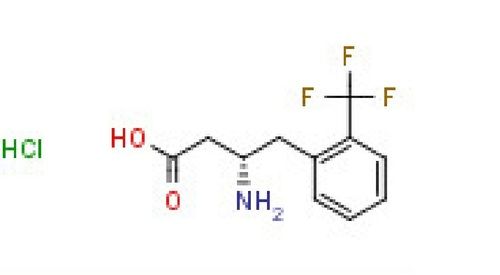
Chemical Name: (S)-3-Amino-4-(2-trifluoromethylphenyl)butanoicacid hydrochloride
Synonyms : (R)-3-AMINO-4-(2-TRIFLUOROMETHYLPHENYL)BUTANOICACID HYDROCHLORIDE |
(R)-3-Amino-4-(2-trifluoromethyl-phenyl)-butyricacid-HCl |
(3R)-3-amino-4-[2-(trifluoromethyl)phenyl]butanoicacid;hydrochloride |
2-Trifluoromethyl-D-beta-homophenylalaninehydrochloride |
(3R)-3-AMINO-4-[2-(TRIFLUOROMETHYL)PHENYL]BUTANOICACID HYDROCHLORIDE
CAS No : 332061-78-6
Purity : 95%
MolecularFormula : C11H12F3NO2.ClH
Molecular Weight: 283.7
Chirality and PurityThe (S)-enantiomer of (S)-3-Amino-4-(2-trifluoromethylphenyl)butanoic acid hydrochloride is optically pure, ensuring high specificity in pharmaceutical synthesis. Its purity level is at least 98%, making it suitable for applications demanding stringent quality standards such as CNS drug development.
Application and UsagePrimarily utilized as an intermediate in pharmaceutical synthesis, this compound is favored for CNS drug research. Its solubility profile in water and DMSO allows easy handling in the laboratory. It serves as a robust choice for research, laboratory experiments, and as a pharma API intermediate.
Safe Handling and StorageAs a non-hazardous and non-flammable material, (S)-PECF is straightforward to handle when standard laboratory precautions are followed. Store it in a cool, dry, well-ventilated environment protected from light, where it remains stable for up to two years.
FAQs of (S)-3-Amino-4-(2-trifluoromethylphenyl)butanoic acid hydrochloride:
Q: How should (S)-3-Amino-4-(2-trifluoromethylphenyl)butanoic acid hydrochloride be stored for optimal stability?
A: For best results, store the compound in a cool, dry, and well-ventilated area, away from direct light. Under these conditions, it remains stable and retains its properties for up to two years.
Q: What are the main benefits of using the (S)-enantiomer in pharmaceutical synthesis?
A: The optically pure (S)-enantiomer ensures specificity and consistency during synthesis, which is vital for developing central nervous system (CNS) drugs and other pharmaceuticals requiring precise chiral intermediates.
Q: When is this compound typically used during pharmaceutical development?
A: It is mainly used at the intermediate stage of pharmaceutical synthesis, particularly in the research and development of CNS-active compounds.
Q: Where can I purchase (S)-PECF, and what packaging options are available?
A: The compound is available through suppliers and traders in India, and it can be ordered in standard packages of 1g, 5g, 10g, or 100g, with customized quantities available upon request.
Q: What is the recommended process for dissolving (S)-PECF in laboratory applications?
A: This compound dissolves readily in water and DMSO, making the preparation of solutions for research straightforward. Use appropriate laboratory techniques to achieve full dissolution.
Q: What are the physical characteristics and appearance of this product?
A: (S)-PECF is a white to off-white crystalline powder, odorless or slightly bitter in taste, with a melting point of 198204C and a molecular weight of 283.69 g/mol.
Q: What safety considerations should I be aware of when handling this compound?
A: Although not classified as hazardous or poisonous under GHS, it should be handled as a chemical reagent, using standard laboratory safety protocols such as gloves and eyewear to prevent accidental contact.






![(3Ar,4r,5r,6as)-4- ((e)-3,3-difluoro-4-phenoxybut-1-en-1-yl)-5-hydroxyhexahydro-2h-cyclopenta[b]furan-2-one](https://cpimg.tistatic.com/10042049/b/4/-3Ar-4r-5r-6as-4-e-3-3-difluoro-4-phenoxybut-1-en-1-yl-5-hydroxyhexahydro-2h-cyclopenta-b-furan-2-one.jpg?tr=w300)
 Send Inquiry
 Send Inquiry
 Send SMS


