Product Description
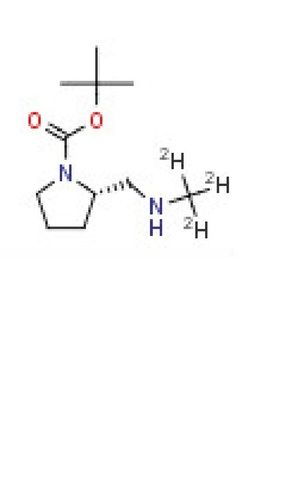
Chemical Name: (S)-1-Boc-2-(n-methyl-d3-aminomethyl)-pyrrolidine
Synonyms : tert-butyl(2S)-2-[(trideuteriomethylamino)methyl]pyrrolidine-1-carboxylate
Cas No : 2065246-75-3
Purity : 95%
MolecularFormula : C11H19D3N2O2
Molecular Weight: 217.3
High-Purity Deuterated Intermediate for ResearchThis (S)-1-Boc-2-(n-methyl-d3-aminomethyl)-pyrrolidine features a precisely deuterated methyl group, making it a specialized starting material or intermediate for pharmaceutical research. Its chiral, Boc-protected structure supports the synthesis of labeled compounds, crucial for metabolic and chiral drug studies. Consistent high purity ensures reliable results across diverse laboratory applications.
Reliable Storage and Easy HandlingPackaged in sealed amber glass bottles and available in several sizes, this product is simple to store and transport. It is stable when kept tightly closed, away from light and moisture, in a cool, dry environment-ensuring a shelf life of 12 to 24 months. As a non-hazardous, solid compound, it is easy to handle with standard precautions under a fume hood.
Versatile Applications in Pharmaceutical ResearchUsed predominantly in ADME research and chiral drug synthesis, this compound enables the creation of isotopically labeled pharmaceuticals. Its deuterium label facilitates advanced metabolic and tracing studies, helping scientists generate deeper insights into drug behavior and efficacy.
FAQ's of (S)-1-Boc-2-(n-methyl-d3-aminomethyl)- pyrrolidine:
Q: How should (S)-1-Boc-2-(n-methyl-d3-aminomethyl)-pyrrolidine be properly handled in the laboratory?
A: Handle this compound in a well-ventilated chemical fume hood, wearing appropriate personal protective equipment. Avoid contact with skin and eyes, and do not ingest or inhale. Always use standard laboratory safety protocols.
Q: What are the main applications of this deuterated pyrrolidine derivative?
A: This compound is primarily used as a starting material or intermediate in pharmaceutical research. Its isotopic labeling and chirality make it especially valuable for ADME studies and the synthesis of chiral or labeled drugs.
Q: When is it recommended to use this product in research projects?
A: Utilize this compound when conducting metabolic, pharmacokinetic, or chiral drug synthesis experiments that require isotopically labeled intermediates or high chemical purity for reliable outcomes.
Q: Where is the best location and manner to store this compound?
A: Store the material in its original sealed amber glass container, in a cool, dry, and dark place. Protect it from moisture and direct light, and keep the container tightly closed to maintain stability and shelf life.
Q: What is the process for acquiring larger quantities or requesting a detailed structural formula?
A: For bulk orders or structural information, contact your supplier or trader in India. Requests for detailed chemical structures can be fulfilled upon inquiry, often provided with your purchase or through direct communication.
Q: How does the deuterium labeling benefit ADME studies?
A: Deuterium atoms in the methyl group enable more precise tracking and quantitation during metabolic studies, improving the clarity of pharmacokinetic data and helping to trace drug pathways more effectively.






![4-[Methyl-d3-sulfamoyl]benzoic acid](https://cpimg.tistatic.com/09676400/b/4/4-Methyl-d3-sulfamoyl-benzoic-acid.jpg?tr=w300)
 Send Inquiry
 Send Inquiry
 Send SMS


