Product Description
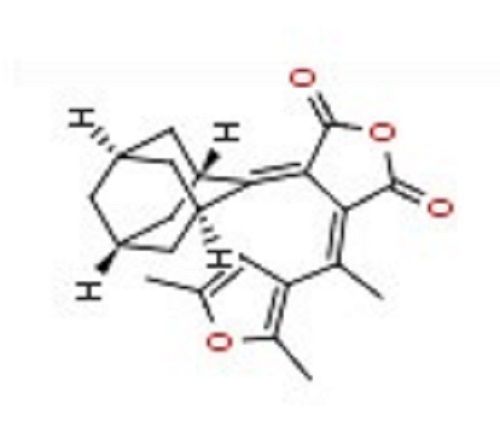
Chemical Name: (E)-3-((1r,3r,5R,7S)-Adamantan-2-ylidene)-4-(1-(2,5-dimethylfuran-3-yl)ethylidene)dihydrofuran-2,5-dione
Synonyms :(4E)-3-(2-adamantylidene)-4-[1-(2,5-dimethylfuran-3-yl)ethylidene]oxolane-2,5-dione
| (E)-3-(adamantan-2-ylidene)-4-(1-(2,5-dimethylfuran-3yl)ethylidene) dihydrofuran-2,5-dione
Cas No : 94856-25-4
Purity : 95%
MolecularFormula : C22H24O4
Molecular Weight :352.4Key Features and StructureThis derivative incorporates adamantane and dimethylfuran functionalities alongside a maleic anhydride core, resulting in a molecule suitable for advanced organic synthesis. Its crystalline, off-white to pale yellow form, and distinct structural elements provide both stability and reactivity for chemical research.
Packaging and Purity AssuranceThe compound is available in 1g, 5g, and 10g airtight glass bottles. Each batch undergoes rigorous purity analysis, confirmed by HPLC and NMR, ensuring research-grade standards (98% purity) are consistently maintained.
Applications in Research and IndustryPrimarily used as an intermediate in pharmaceutical research, synthetic chemistry, and material science, this compound supports development of novel drugs and materials. Its unique chiral and conjugated structure enables precision in modern chemical transformations.
Safe Handling and StorageWith no hazardous classification and a 24-month shelf life, handling is straightforward: store in a cool, dry, well-ventilated area, protected from moisture and light. Its mild, faint organic odor makes it user-friendly in laboratories.
FAQ's of (E)-3-((1r,3r,5R,7S)-Adamantan-2-ylidene)-4- (1-(2,5-dimethylfuran-3-yl)ethylidene)dihydrofuran-2,5-dione:
Q: How should (E)-3-((1r,3r,5R,7S)-Adamantan-2-ylidene)-4-(1-(2,5-dimethylfuran-3-yl)ethylidene)dihydrofuran-2,5-dione be stored for maximum shelf life?
A: It is best stored in a cool, dry place away from moisture and direct light, ideally in its original airtight glass bottle. Under these conditions, the compound remains stable for up to 24 months.
Q: What are the main research and industrial applications of this compound?
A: The compound serves primarily as an intermediate in advanced organic synthesis, pharmaceutical research, and material sciences, making it integral for producing drug candidates or novel functional materials.
Q: When is this compound typically used during the synthetic process?
A: This derivative is often employed during the intermediate stages of organic synthesis, especially when constructing complex chiral frameworks or conjugated systems for research and development.
Q: Where is this compound manufactured and supplied from?
A: It is produced and supplied by a specialty chemical manufacturer based in India, ensuring quality control through analytical techniques like HPLC and NMR.
Q: How can researchers benefit from the chiral and conjugated structure of this compound?
A: The presence of chiral centers and a conjugated diene system allows researchers to create stereochemically complex molecules and participate in enantioselective reactions, enhancing the study of new drugs and materials.
Q: What precautions are necessary when handling this compound in the laboratory?
A: While it is not classified as hazardous or poisonous, standard laboratory precautions should be observed, such as avoiding exposure to moisture and wearing appropriate protective equipment.






 Send Inquiry
 Send Inquiry
 Send SMS
 Call Me Free


