Product Description
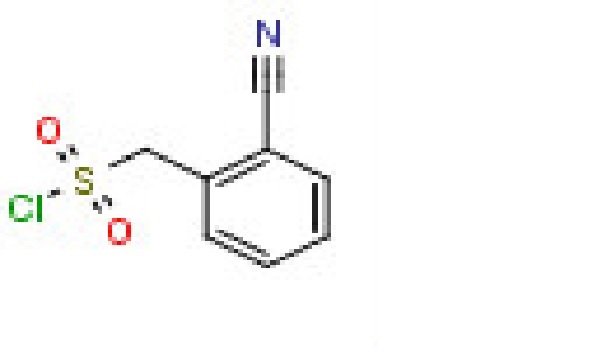
Chemical Name:(2-Cyanophenyl)methanesulfonyl chloride
Synonyms : (2-cyano-phenyl)-methanesulfonylchloride
CAS No : 51045-34-2
Purity : 96%
MolecularFormula : C8H6ClNO2S
Molecular Weight: 215.7
Appearance: SolidHigh Reactivity and VersatilityThis compound's robust reactivity makes it a valuable reagent for introducing the methanesulfonyl chloride group in a variety of chemical reactions. Its application as an intermediate spans across pharmaceuticals, agrochemicals, and fine chemical syntheses, underscoring its versatility in high-value research and industrial processes.
Safe Handling and StorageDue to its moisture sensitivity, lachrymatory nature, and corrosivity, (2-Cyanophenyl)methanesulfonyl chloride should be handled exclusively with appropriate personal protective equipment in a well-ventilated area or fume hood. Store the product sealed, in a cool and dry location, to prevent decomposition or unwanted reactions.
FAQ's of (2-Cyanophenyl)methanesulfonyl chloride:
Q: How should (2-Cyanophenyl)methanesulfonyl chloride be safely handled during use?
A: It must be handled in a fume hood while wearing protective gloves and eye protection, as the compound is corrosive, causes burns, and can harm eyes and the respiratory system.
Q: What are the primary uses of (2-Cyanophenyl)methanesulfonyl chloride?
A: This chemical acts as an intermediate in the synthesis of pharmaceuticals, agrochemicals, and other organic compounds, and as a reagent to introduce the methanesulfonyl chloride group in organic synthesis.
Q: When does this product typically decompose, and are there any special considerations regarding its boiling point?
A: (2-Cyanophenyl)methanesulfonyl chloride decomposes before reaching its boiling point, thus direct boiling is not recommended. Thermal stability is maintained under proper storage conditions.
Q: Where should (2-Cyanophenyl)methanesulfonyl chloride be stored for optimal shelf life?
A: It should be stored in tightly sealed containers, placed in a cool, dry, and well-ventilated area, away from moisture, to retain its stability and extend its shelf life up to 2 years.
Q: What is the recommended process for disposing of waste or spills of this compound?
A: Waste and spills should be managed as hazardous material-use absorbents for solid containment, ensure proper ventilation, and follow local chemical waste disposal regulations. Avoid water contact due to possible hydrolysis and decomposition.
Q: How does the product's benefit manifest in chemical synthesis?
A: Its high reactivity and selective introduction of the methanesulfonyl chloride group enable efficient reactions, simplifying multi-step synthesis in pharmaceuticals and specialty chemicals.






![3-[({2-[(Diaminomethylidene)amino]-1,3-thiazol-4-yl}methyl)sulfanyl]-N- sulfamoylpropanimidamid](https://cpimg.tistatic.com/10878476/b/4/3-2-Diaminomethylidene-amino-1-3-thiazol-4-yl-methyl-sulfanyl-N-sulfamoylpropanimidamid.jpg?tr=w300)
 Send Inquiry
 Send Inquiry
 Send SMS


