Product Description
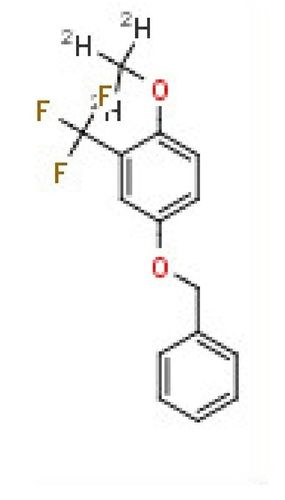
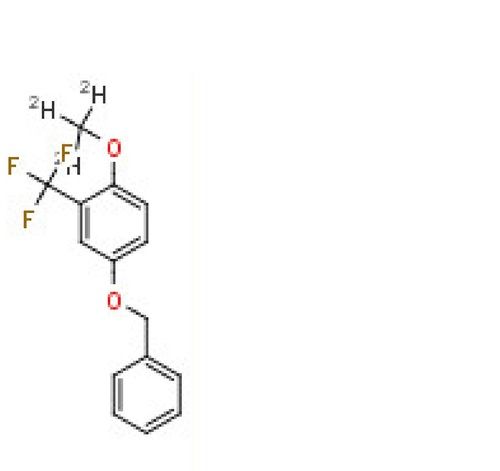
Chemical Name: 4-(Benzyloxy)-1-(methoxy-d3)-2-(trifluoromethyl)benzene
Synonyms : 4-Phenylmethoxy-1-(trideuteriomethoxy)-2-(trifluoromethyl)benzene
Cas No : 2140317-12-8
Purity : 97%
MolecularFormula : C15H10D3F3O2
Molecular Weight: 285.3
Appearance: SolidSuperior Deuterium Incorporation for Precision ResearchThis compound features deuterium incorporation exceeding 99% within the methoxy group, making it ideal for use as a highly accurate internal standard or labeling reagent. Its exceptional isotopic purity supports reliable quantitative and qualitative measurements, particularly in pharmaceutical, medicinal, and analytical research. Applications include NMR spectroscopy, synthetic modification, and advanced method development.
Safe and Stable for Laboratory ApplicationsClassified as non-hazardous for laboratory use, 4-(Benzyloxy)-1-(methoxy-d3)-2-(trifluoromethyl)benzene offers chemical stability when stored as directed. Provided in sealed glass containers to protect from moisture and light, the compound maintains integrity for up to 24 months. Always handle under inert atmosphere, avoiding skin and eye contact, to ensure both safety and maximum shelf life.
FAQ's of 4- (Benzyloxy)-1-(methoxy-d3)-2-(trifluoromethyl)benzene:
Q: How should 4-(Benzyloxy)-1-(methoxy-d3)-2-(trifluoromethyl)benzene be handled and stored?
A: It should be handled under an inert atmosphere and contact with skin or eyes should be avoided. Store it in a tightly closed, sealed glass vial in a cool, dry place, away from light and moisture, to preserve stability and maximize shelf life.
Q: What are the main uses of this deuterium-labeled compound in research?
A: This compound serves as a deuterium-labeled internal standard or labeling reagent, mainly for NMR spectroscopy, quantitative chemical analysis, and as a precursor for synthetic modification or further functionalization in pharmaceutical and chemical research.
Q: When is this compound most beneficial to use?
A: It is most beneficial when high isotopic purity is required, such as in applications demanding precise quantification or structure elucidation via NMR, or in research involving metabolic studies and tracer experiments.
Q: Where is this product typically applied within a laboratory or research process?
A: The compound is typically used in analytical laboratories for method development, in synthetic laboratories as a labeling reagent, and in pharmaceutical R&D for standards in identification and quantification of compounds.
Q: What is the process for using this compound in analytical experiments?
A: Add the required quantity directly from the sealed vial under an inert atmosphere, dissolve in a compatible solvent (e.g., DMSO or dichloromethane), and proceed with your analytical or synthetic protocol as indicated by your research method.
Q: Can this compound be used for any non-laboratory applications?
A: No, this product is strictly intended for research use only and is not approved for drug, household, or other non-laboratory applications.







 Send Inquiry
 Send Inquiry
 Send SMS


