Product Description
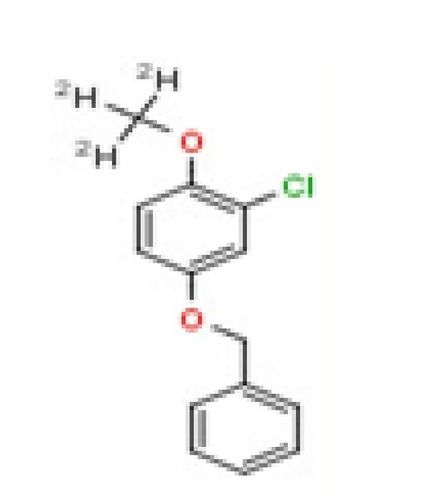
Chemical Name: 4-(Benzyloxy)-2-chloro-1-(methoxy-D3)benzene
Synonyms : 2-Chloro-4-phenylmethoxy-1-(trideuteriomethoxy)benzene
Cas No : 2222512-16-3
Purity : 98%
MolecularFormula : C14H13ClO2
Molecular Weight: 251.7
Appearance: Solid
Broad Applications in Research and DevelopmentAs an advanced deuterium-labeled compound, 4-(Benzyloxy)-2-chloro-1-(methoxy-D3) benzene finds significant use in isotopic labeling studies, pharmaceutical intermediate synthesis, and other laboratory research ventures. Its high D incorporation and purity ensure reliability for demanding analytical experiments.
Stability and Safety for Laboratory WorkThe compound remains stable under recommended storage conditions (cool, dry, and sealed). Not classified as hazardous by GHS, it poses minimal risk when standard laboratory precautions-like using personal protective equipment and avoiding inhalation or skin contact-are observed.
Customizable Packaging to Meet Diverse NeedsAvailable in customizable vial sizes (typically 100mg, 500mg, 1g), this compound meets various experimental scales. Its solid crystalline form allows for ease of handling, storage, and precise measurement in laboratory workflows.
FAQ's of 4-(Benzyloxy)-2-chloro-1-(methoxy-D3) benzene:
Q: How should 4-(Benzyloxy)-2-chloro-1-(methoxy-D3) benzene be stored to ensure maximum stability?
A: It should be stored tightly sealed in a cool, dry location. Under these conditions, the compound remains stable and retains its properties for up to 24 months.
Q: What are the primary uses and benefits of this deuterium-labeled compound?
A: This compound is primarily used in isotopic labeling studies, as a pharmaceutical intermediate, and in research and development. Its high deuterium incorporation enhances analytical accuracy in traceability and mechanistic studies.
Q: When is special handling required for this chemical?
A: Special handling is always advised; personal protective equipment should be used at all times to avoid contact or inhalation, despite the compound not being classified as hazardous.
Q: Where is this compound typically utilized?
A: The product is suited for laboratory and analytical environments, including pharmaceutical research facilities and institutions engaged in chemical and isotopic research. It is not intended for household or therapeutic purposes.
Q: What is the process for customizing the packaging size of this compound?
A: Packaging size can be tailored to requirements, commonly offered in 100mg, 500mg, and 1g vials. Orders can specify the needed quantity, enabling flexibility for various lab scales.
Q: Is the compound safe for transportation and what precautions should be considered during shipping?
A: This substance is classified as non-hazardous for transport but should be protected from extreme conditions such as high heat or moisture during shipping to preserve its quality.
Q: What advantages does >98% deuterium incorporation provide in research?
A: High deuterium incorporation ensures consistency and efficacy in isotopic labeling studies, allowing researchers to accurately track molecular transformations and study reaction mechanisms.








 Send Inquiry
 Send Inquiry
 Send SMS


