Product Description
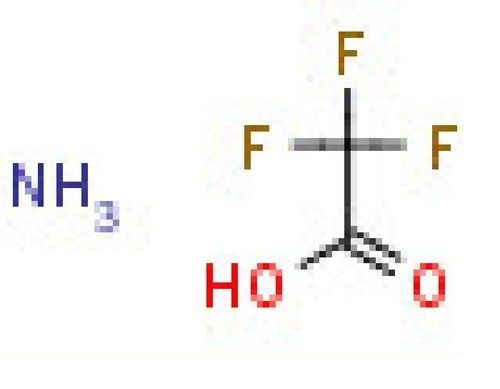
Chemical Name: Ammoniumtrifluoroacetate
Synonyms : Trifluoroaceticacid ammonium salt |
azane;2,2,2-trifluoroaceticacid |
amine-trifluoroaceticacid |
trifluoroaceticacid amine |
Ammoniumtrifluoroacetate |
ammonia;2,2,2-trifluoroacetic acid
CAS No : 3336-58-1
Purity : 97%
Molecular Formula :C2HF3O2.H3N
Molecular Weight: 131.1
Appearance: Solid
Superior Performance in Analytical ChemistryEngineered to deliver outstanding results as an Analytical Reagent (>99% purity), Ammonium trifluoroacetate is crucial for high-precision buffer formulations and as an ion-pairing reagent in HPLC. Its pure crystalline structure ensures dependable, reproducible outcomes across research and quality control laboratories.
Easy Handling and StorageAmmonium trifluoroacetate is offered in convenient HDPE packaging (25g, 100g, 500g). Being hygroscopic and volatile, it should be stored in tightly closed containers in a cool, dry, well-ventilated environment. Following these guidelines, the shelf life extends up to 24 months, maintaining product integrity.
FAQs of Ammonium trifluoroacetate:
Q: How should Ammonium trifluoroacetate be stored and handled?
A: It should be stored in tightly closed HDPE containers in a cool, dry, and well-ventilated location. Since the powder is hygroscopic and acidic, handling should be done promptly to minimize moisture absorption.
Q: What are the main applications of Ammonium trifluoroacetate?
A: This compound is widely used as a buffer in chemical analyses, as an ion-pair reagent in HPLC, and in synthesis or research related to fluorine-containing chemicals and pharmaceuticals.
Q: When does Ammonium trifluoroacetate decompose instead of boiling?
A: The compound decomposes before reaching its boiling point, which is why it is generally not heated to its melting or boiling range under normal laboratory conditions.
Q: Where can I use Ammonium trifluoroacetate safely in the laboratory?
A: It can be safely utilized in any standard laboratory environment, provided it is kept away from strong bases and oxidizing agents, which can react with the compound.
Q: What benefits does Ammonium trifluoroacetate offer as a buffer or reagent?
A: With its high purity, stability, and significant solubility in water and polar organic solvents, it provides precise pH control and reliable reproducibility in analytical procedures.
Q: How is Ammonium trifluoroacetate manufactured?
A: It is synthesized by neutralizing trifluoroacetic acid with ammonium hydroxide, resulting in a crystalline salt that is then purified and dried.
Q: What process should be followed for disposal?
A: Ammonium trifluoroacetate should be disposed of in accordance with local regulations. Its low toxicity and eco-friendly profile simplify waste handling, but official disposal protocols must always be observed.






 Send Inquiry
 Send Inquiry
 Send SMS
 Call Me Free


