Product Description
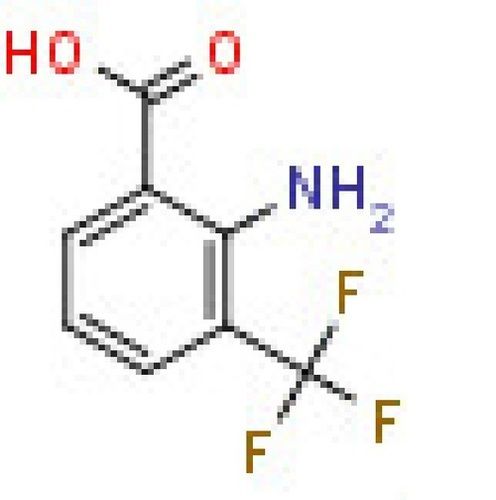
Chemical Name: 2-Amino-3-(trifluoromethyl)benzoicacid
Synonyms : 2-amino-3-trifluoromethylbenzoicacid |
3-Trifluoromethylanthranilicacid |
2-Amino-3-(Trifluoromethyl)BenzoicAcid|
2-amino-3-trifluoromethyl-benzoicacid |
3-(Trifluoromethyl)anthranilicacid |
Benzoic acid,2-amino-3-(trifluoromethyl)-
CAS No : 313-12-2
Purity : 96%
MolecularFormula : C8H6F3NO2
Molecular Weight: 205.1
Appearance: Solid
Versatile Applications in Synthesis2-Amino-3-(trifluoromethyl)benzoic acid is widely used as an intermediate in the synthesis of pharmaceuticals, agrochemicals, and other organic compounds. Its high purity and reliable performance are critical for ensuring consistency in research and industrial applications. With its strong electron-withdrawing trifluoromethyl group, this compound enables greater control in chemical modification processes.
Optimal Storage for Long Shelf LifeTo maximize shelf life and maintain its quality, it is essential to store 2-Amino-3-(trifluoromethyl)benzoic acid in tightly sealed containers at temperatures between 2-8C. Keeping the product protected from light and moisture ensures stability for up to two years. It is typically provided in HDPE bottles or aluminum foil bags for additional security during storage and transport.
FAQs of 2-Amino-3-(trifluoromethyl)benzoic acid:
Q: How should 2-Amino-3-(trifluoromethyl)benzoic acid be safely handled in the laboratory?
A: When working with this compound, always use gloves, safety glasses, and protective clothing to prevent irritation of the eyes, skin, and respiratory system. Ensure that adequate ventilation is available and avoid direct contact or inhalation of dust.
Q: What are the primary applications of 2-Amino-3-(trifluoromethyl)benzoic acid?
A: It is primarily used as a synthetic intermediate in the production of pharmaceuticals, agrochemicals, and other fine chemicals, owing to its unique trifluoromethyl group and high purity.
Q: When does 2-Amino-3-(trifluoromethyl)benzoic acid decompose, and what is its melting point?
A: This compound decomposes before it reaches its boiling point and has a melting point between 170-174C, indicating high thermal stability under normal laboratory conditions.
Q: Where should this chemical be stored to maintain its stability and effectiveness?
A: It should be stored in a cool, dry environment at 2-8C in tightly closed containers, away from light and moisture, to preserve its quality and extend shelf life.
Q: What is the process for using this material as a building block in chemical synthesis?
A: It can be dissolved in suitable organic solvents such as DMSO or methanol and incorporated into reaction schemes as an electron-withdrawing aromatic intermediate to facilitate targeted modifications.
Q: What are the benefits of using 2-Amino-3-(trifluoromethyl)benzoic acid in organic synthesis?
A: Its trifluoromethyl group enhances the electron-withdrawing effect, increasing reaction selectivity and efficiency, making it highly valuable for developing new and complex chemical entities.






 Send Inquiry
 Send Inquiry
 Send SMS


